Business Security & Access Control Systems in Fort Worth — Complete 2025 Guide
Business security in Fort Worth goes far beyond a lock on the front door. With commercial burglary rates climbing across Tarrant County and employee theft costing U.S. businesses $50 billion annually, Fort Worth business owners need layered security strategies that combine physical locks, electronic access control, surveillance, and smart policies. The right system protects your assets, your employees, and your liability.
This complete 2025 guide covers every aspect of commercial security for Fort Worth businesses — from choosing the right locks and access control systems to designing master key hierarchies, implementing surveillance, and meeting insurance requirements. Whether you run a small retail shop in the Stockyards, a medical office in the hospital district, or a warehouse in the Alliance corridor, this guide helps you build security that fits your specific needs and budget.
Why Fort Worth Businesses Need Professional Security Assessments
Most business owners underestimate their security vulnerabilities until a break-in happens. A professional security assessment identifies weak points before criminals do. Fort Worth's commercial landscape presents unique challenges: strip malls with shared walls, aging downtown buildings with outdated hardware, industrial parks with minimal lighting, and mixed-use developments where public and private spaces blur together.
A commercial locksmith security assessment typically costs $100–$200 in Fort Worth and evaluates every entry point, existing lock hardware, lighting conditions, key control practices, and employee access patterns. The assessment produces a prioritized list of recommendations ranked by impact and cost. Most businesses recover the assessment cost many times over by avoiding unnecessary upgrades and focusing on the changes that matter most.
Commercial Lock Types: What Every Business Needs
High-Security Deadbolts
Standard residential-grade deadbolts (ANSI Grade 3) are inadequate for commercial use. Fort Worth businesses should install ANSI Grade 1 commercial deadbolts at minimum. Brands like Medeco, Mul-T-Lock, and Abloy offer pick-resistant, drill-resistant, and bump-resistant cylinders that provide genuine security. High-security deadbolts cost $200–$500 per door installed but represent the most cost-effective physical security upgrade for any business.
Panic Bars and Exit Devices
Texas fire code requires panic hardware on exit doors in commercial buildings with occupancy over 50 people. Panic bars (also called crash bars or exit devices) allow instant egress in emergencies while preventing unauthorized entry from outside. Professional installation ensures compliance with both fire code and security requirements. Expect to pay $300–$600 per door for quality panic hardware plus installation in Fort Worth.
Mortise Locks
Mortise locks are the gold standard for commercial door hardware. Unlike cylindrical locks that mount through a single bore hole, mortise locks install into a pocket cut into the door edge, providing superior strength and durability. They're standard on commercial glass storefronts, office suite doors, and institutional buildings. Mortise lock installation runs $400–$800 per door depending on the door type and lock grade.
Access Control Systems: Beyond Traditional Keys
Traditional keys are the weakest link in commercial security. Keys get copied without authorization, lost employees retain access, and there's no audit trail of who entered where and when. Modern access control systems solve all three problems while adding convenience and scalability.
Key Card and Fob Systems
Proximity card systems (HID, AWID) are the most common access control for Fort Worth businesses. Employees tap a card or fob to unlock doors. When someone leaves the company, their credential is deactivated in seconds — no rekeying required. The system logs every access event with timestamps. Basic key card systems for a single door start at $1,500–$2,500 installed. Multi-door systems with networked management run $3,000–$10,000 depending on scale.
Mobile Credential Systems
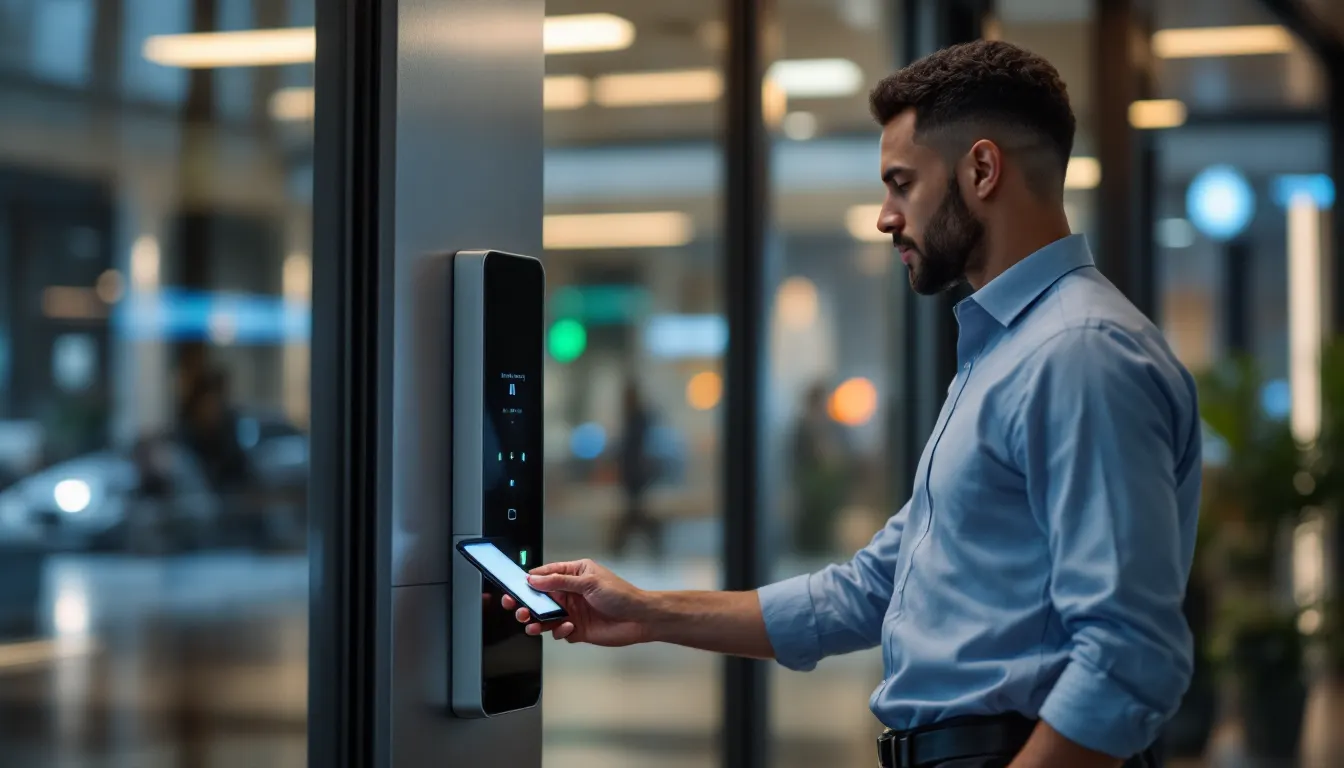
The newest generation of access control uses smartphones as credentials via Bluetooth or NFC. Employees unlock doors with their phone — no card to lose or forget. Systems like Openpath, Brivo, and Verkada offer cloud-managed mobile access with remote administration. Fort Worth property managers particularly value mobile credentials for multi-tenant buildings because they eliminate physical key and card management entirely.
Biometric Access Control
Fingerprint readers, facial recognition, and iris scanners provide the highest security because credentials can't be shared, lost, or stolen. Biometric systems are ideal for server rooms, pharmaceutical storage, cash handling areas, and any space requiring strict access verification. Standalone biometric locks start at $500–$1,000 per door. Networked biometric systems with management software run $2,000–$5,000 per door.
Master Key Systems: Organized Access for Every Business
A master key system creates a hierarchy of access levels using traditional mechanical keys. Each employee gets a key that only opens the doors they need, while managers hold master keys that open broader sets of doors, and the owner holds a grand master key that opens everything. Well-designed master key systems serve Fort Worth businesses ranging from small offices to large commercial complexes.
How master key levels work: A three-level system might include individual change keys for each office or suite, sub-master keys for department managers that open all doors within their department, and a grand master key for the building owner or property manager that opens every lock in the building. Professional locksmiths design these systems to be expandable — you can add new locks and key levels without replacing existing hardware.
Master key system design and installation typically costs $150–$300 per lock in Fort Worth, including new high-security cylinders and all cut keys. For a 20-door office, expect $3,000–$6,000 for a complete master key system. This is significantly less expensive than electronic access control while providing organized access management that traditional random keying can't match.
The access methods covered above compare like this, as of August 2026:
| Access method | What it suits | Trade-off |
|---|---|---|
| Traditional keys | Very small sites with few doors and stable staff | Copied without authorization, departed staff keep access, no audit trail |
| Master key system | Offices and complexes wanting organized, expandable access levels on mechanical hardware | Still mechanical — no electronic audit trail of who entered when |
| Key card / fob (prox) | Most Fort Worth businesses; credentials deactivate in seconds when someone leaves | Cards can be lost or handed off; networked multi-door management adds scale and cost |
| Mobile credential (smartphone) | Multi-tenant buildings and property managers eliminating physical key and card handling | Depends on employee phones and cloud-managed administration |
| Biometric | Server rooms, pharmaceutical storage, cash handling and strict-verification spaces | Highest cost per door — best reserved for the few openings that need it |
Surveillance and Camera Systems
Security cameras serve three functions: deterrence, real-time monitoring, and evidence collection. Fort Worth businesses should prioritize camera placement at all entry and exit points, cash handling areas, parking lots, loading docks, and any area with valuable inventory. Modern IP camera systems offer remote viewing from your smartphone, motion-triggered recording, and cloud storage.
Budget-friendly systems from Reolink or Amcrest provide quality coverage for $500–$1,500 for 4–8 cameras. Enterprise-grade systems from Verkada, Rhombus, or Avigilon with AI-powered analytics run $5,000–$20,000 depending on camera count and features. A commercial locksmith can integrate camera systems with access control so you see who's at the door before granting access remotely.
Industry-Specific Security Requirements in Fort Worth
Retail and Restaurant Security
Fort Worth retail businesses face both external theft and internal shrinkage. Key security measures include high-security locks on all perimeter doors, restricted key access for opening and closing staff, safes for cash management with time-delay locks, camera coverage of registers, storage rooms, and back doors, and panic buttons connected to monitoring services. Regular lock rekeying is essential when retail employees turn over.
Medical and Healthcare Facility Security
Fort Worth's medical district and healthcare facilities have HIPAA compliance requirements that extend to physical security. Patient records rooms, pharmaceutical storage, and server rooms need access control with audit trails. Many healthcare facilities in Fort Worth are upgrading from mechanical keys to electronic access specifically to meet HIPAA physical safeguard requirements. Biometric access for pharmaceutical storage is becoming standard practice.
Office and Professional Services
Multi-tenant office buildings in Fort Worth require security that balances individual tenant privacy with building management access. Master key systems or electronic access control with management overrides serve this need. Common area access, after-hours building entry, and tenant suite security all need coordinated solutions. Professional office locksmith services ensure each tenant has secure, independent access while the property manager retains emergency override capability.
Insurance Requirements and Security Discounts
Many Fort Worth business insurance policies require specific security measures as conditions of coverage. Failing to meet these requirements can result in denied claims after a break-in. Common insurance requirements include commercial-grade deadbolts on all exterior doors, monitored alarm systems, security camera systems with recording capability, and restricted key control documentation.
Conversely, exceeding minimum security requirements often qualifies businesses for insurance premium discounts of 5–20%. High-security locks, access control systems, and monitored surveillance can pay for themselves through reduced premiums within 2–3 years. Ask your insurance provider about available security discounts before investing in upgrades — it may change your priorities.
Emergency Locksmith Services for Fort Worth Businesses
Commercial lockouts and security emergencies don't follow business hours. A broken lock at 5am before your restaurant opens, a malfunctioning panic bar discovered during a fire inspection, or a terminated employee who won't return keys — these situations require immediate emergency commercial locksmith response. Establish a relationship with a commercial locksmith before emergencies happen so you have a trusted number to call.
Conclusion: Building Layered Security for Your Fort Worth Business
Effective business security is layered — no single measure is sufficient on its own. The foundation is quality commercial locks on every entry point. Access control adds accountability and management convenience. Surveillance provides deterrence and evidence. Smart policies like key control protocols and employee security training tie everything together. Start with a professional security assessment, prioritize the highest-impact upgrades, and build your security program over time.
For commercial locksmith services, security assessments, master key systems, and access control installation anywhere in Fort Worth, Arlington, Dallas, or throughout the DFW metroplex, call Fort Worth Locksmith & Computer Programming at (817) 668-3801. We design, install, and maintain commercial security systems for businesses of all sizes.
What experienced commercial locksmiths say
“Commercial-grade lock specification comes down to UL listing and BHMA grade. Grade 1 locks tested to ANSI/BHMA A156 standards are the floor for any commercial application — anything below that is a residential-grade product being sold into commercial use, and it shows up in insurance and warranty claims the moment something goes wrong. Specify Grade 1 on every keyed opening that controls access to cash, inventory, or sensitive data.”
— ALOA-credentialed commercial locksmith, 13 years DFW (anonymized)
Fire-rated commercial doors additionally must comply with NFPA 80 (Standard for Fire Doors and Other Opening Protectives) — relevant for any commercial property with a CO requiring fire-rated egress.
Frequently Asked Questions
How much does a commercial security assessment cost in Fort Worth?
A commercial locksmith security assessment typically costs $100-$200 in Fort Worth. It evaluates every entry point, the existing lock hardware, lighting conditions, key control practices and employee access patterns, then produces a prioritized list of recommendations ranked by impact and cost. Most businesses recover that cost many times over by skipping upgrades they do not need and spending on the changes that actually matter. It is the right first step before buying any hardware.
What lock grade does a Fort Worth business need?
Standard residential-grade deadbolts at ANSI Grade 3 are inadequate for commercial use. Fort Worth businesses should install ANSI Grade 1 commercial deadbolts at minimum, and brands like Medeco, Mul-T-Lock and Abloy offer pick-resistant, drill-resistant and bump-resistant cylinders that provide genuine security. High-security deadbolts cost $200-$500 per door installed. For the money, it is the most cost-effective physical security upgrade available to any business.
Does my business need panic bars on its exit doors?
Texas fire code requires panic hardware on exit doors in commercial buildings with occupancy over 50 people. Panic bars, also called crash bars or exit devices, allow instant egress in an emergency while still preventing unauthorized entry from outside. Expect to pay $300-$600 per door for quality panic hardware plus installation in Fort Worth. Professional installation matters here because the hardware has to satisfy both fire code and security requirements at the same time.
How does a master key system organize access?
A master key system builds a hierarchy of access levels on traditional mechanical keys. A three-level system typically gives each office or suite its own change key, department managers a sub-master that opens every door in their department, and the owner or property manager a grand master that opens every lock in the building. Professional locksmiths design these to be expandable, so you can add locks and key levels later without replacing existing hardware. Design and installation runs $150-$300 per lock in Fort Worth including new high-security cylinders and all cut keys.
Why switch from traditional keys to access control?
Traditional keys are the weakest link in commercial security for three reasons: they get copied without authorization, departed employees keep whatever access they had, and there is no record of who entered where and when. Access control fixes all three. When someone leaves the company their credential is deactivated in seconds with no rekeying required, and the system logs every access event with a timestamp. Basic key card systems for a single door start at $1,500-$2,500 installed, with multi-door networked systems running $3,000-$10,000 depending on scale.
Will better security lower my business insurance?
It can work both ways. Many Fort Worth business policies require specific measures as conditions of coverage — commercial-grade deadbolts on exterior doors, monitored alarm systems, camera systems with recording capability, and restricted key control documentation — and failing to meet them can mean a denied claim after a break-in. Exceeding the minimums often qualifies you for premium discounts of 5-20%, which can pay for the upgrades within 2-3 years. Ask your insurance provider what discounts are available before you invest, because it may change your priorities.
Where should security cameras go in a commercial building?
Prioritize all entry and exit points, cash handling areas, parking lots, loading docks, and any area holding valuable inventory. Modern IP camera systems give you remote viewing from a smartphone, motion-triggered recording and cloud storage. Budget-friendly systems from Reolink or Amcrest cover 4-8 cameras for $500-$1,500, while enterprise-grade systems from Verkada, Rhombus or Avigilon with AI-powered analytics run $5,000-$20,000. A commercial locksmith can integrate cameras with access control so you can see who is at the door before granting entry remotely.