Instrument Cluster Programming Cost in Fort Worth (2026)
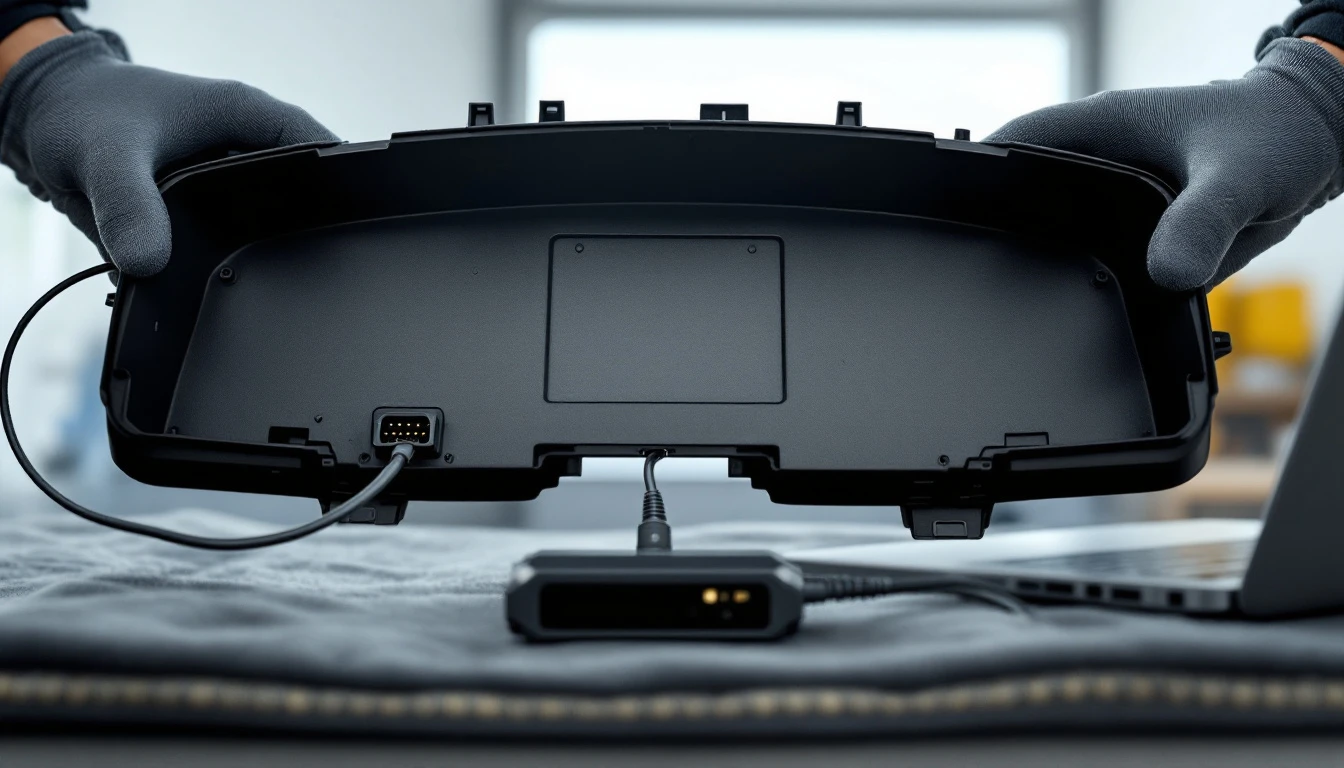
As of October 2026, instrument cluster programming in Fort Worth costs $150–$350 from a mobile specialist for a replacement cluster with a true mileage transfer on most domestic and Asian vehicles, and $250–$450 when the cluster also holds immobilizer data and the keys have to be re-synced. Dealerships typically charge $325–$650 and $525–$900 for the same two jobs. Bench-level work and gateway-protected European clusters are quoted after diagnosis, and the cluster itself is a separate part cost.
The price is set by what the cluster does on your particular vehicle, not by the brand. A cluster that only displays information is a short job. A cluster that takes part in the anti-theft handshake is a longer one. This guide breaks the cost down by job type, explains what moves the number, and covers what federal law requires when a cluster with a different mileage goes into your vehicle.
We are a mobile-only service. The work is done where the vehicle sits, anywhere in Fort Worth and the surrounding Tarrant County area.
What Each Cluster Job Costs
Prices below are the same ranges we publish on our instrument cluster programming guide, organized here by the job you are actually buying.
| Job | Mobile specialist | Dealership | When it applies |
|---|---|---|---|
| Configure a replacement cluster and transfer true mileage (domestic and Asian) | $150–$350 | $325–$650 | The cluster displays data but is not part of the anti-theft system |
| Cluster swap with immobilizer re-coding | $250–$450 | $525–$900 | The cluster stores key data or shares a security code with the engine computer |
| Cluster swap plus a full key re-learn (all keys) | Quoted after diagnosis | Often refused | Platforms where pairing the cluster erases the stored keys |
| Bench-level cluster memory work (older and some European) | Quoted after diagnosis | $700–$1,600+ | No path through the diagnostic port; the cluster is opened |
| European or gateway-protected cluster | Quote required after diagnosis | Dealer-level | Encrypted gateway or component protection |
| Repair of the original cluster | Quoted after diagnosis | Usually replace only | Dead gauges, dark display, failed backlighting |
Every figure assumes a legitimate, accurate mileage transfer. The part is extra: a used cluster from a salvage yard is commonly the least expensive route, a remanufactured unit sits in the middle, and a new cluster from the dealer parts counter is the most expensive.
Why the dealer number is higher
A dealership bills bay labor by the hour and adds software and module fees on top. Many dealers will also only program a brand-new cluster bought through their own parts department and decline to work with a used one. An independent programmer charges a flat rate, comes to the vehicle, and can usually work with a sound used unit, which is where most of the saving comes from.
What Changes the Price
Six things move a cluster job from the low end of a range to the high end, or out of the published ranges and into a quote.
1. Whether the cluster is part of the anti-theft system
This is the largest single factor. On many vehicles the cluster is only a display. On others it is one of the modules in the immobilizer chain. Several Ford platforms store key information in the cluster. Many Volkswagen and Audi models from the 2000s and 2010s keep the immobilizer inside the cluster itself. On a number of Chrysler, Dodge and Jeep vehicles the cluster is on the security network and has to agree with the other modules about the vehicle's identity.
When the cluster is in that chain, a swap is two jobs: configuring the cluster, then restoring the security relationship so the engine starts. That is the difference between the $150–$350 row and the $250–$450 row.
2. New, remanufactured or used
A new cluster arrives blank and is configured to the vehicle. A used cluster arrives carrying another vehicle's VIN, mileage and options, and sometimes its security data, all of which have to be replaced with yours. Used is cheaper to buy and slightly more work to program. On supported platforms the total is still well below a new part. Our used module programming cost guide explains when a used module is a sound choice and when it is a trap.
3. Part number and hardware match
A cluster has to match on more than appearance. The part number, the hardware revision, and the option content (tachometer or not, driver information display type, gauge layout, metric or US units) all matter. A cluster with the wrong hardware cannot be made right with software. Send us the part number from the label on your original cluster before you buy a replacement, and we will tell you whether a candidate unit is compatible.
4. Port access or bench access
Most modern domestic and Asian clusters are programmed through the diagnostic port with the cluster installed. Some older vehicles and some European platforms have no port path for the data that needs to move. The cluster is removed, opened, and its memory chip is read and written directly. That is slower, more delicate work, and it is quoted after we identify the exact unit.
5. Security gateways and component protection
Many 2018-and-newer vehicles place a secure gateway between the diagnostic port and the modules. Programming through it requires an authorized, logged session. Volkswagen and Audi add component protection, which ties certain modules to the vehicle through the manufacturer's server. These are solvable on many platforms and not on all of them. We tell you which side of that line your vehicle falls on before we take the job, the same way we handle ECU programming.
6. Whether the keys have to be re-learned
On some platforms, pairing a cluster wipes the list of programmed keys. Every key you own then has to be present and re-learned, and some manufacturers enforce a security wait before the process will complete. If one of your keys is at home in a drawer, it will stop starting the car until it is added back. We ask you to have every key on site for that reason.
What the Law Requires When a Cluster Is Replaced
This is the part of a cluster job that owners most often get wrong, and it is worth a few paragraphs because the consequences land at resale.
Federal odometer law makes it illegal to alter an odometer with the intent to change the mileage it registers. The same law anticipates that odometers are sometimes repaired or replaced, and it sets a rule for that. If the mileage can be kept the same through the repair or replacement, it must be. If it cannot, the odometer must be set to zero, and a written notice stating the mileage before the service and the date of the service must be attached to the left door frame of the vehicle. Removing or altering that notice is itself prohibited. The National Highway Traffic Safety Administration publishes consumer guidance on odometer fraud at nhtsa.gov.
In practice that leaves three legitimate outcomes:
- The true mileage is transferred into the replacement cluster. This is the normal result on supported platforms, and nothing further is required because the odometer still tells the truth.
- The original cluster is repaired, keeping its own mileage. Nothing changes.
- The mileage cannot be carried over, the odometer is set to zero, and the door-frame notice is applied. This is uncommon on modern vehicles but it is the lawful fallback.
What is not on that list is installing a used cluster and leaving the donor's lower mileage in place, or asking for a number "close to" the real one. We document the mileage before and after, we transfer the true figure, and we decline anything else.
Two practical notes. First, on many vehicles the mileage is also stored in a second module, such as the engine computer or the body control module. A cluster showing a figure that disagrees with those modules can set a warning indicator on the display and will be visible to any shop that scans the car. Second, take a dated photograph of your odometer before the old cluster fails completely or is removed. If the original display is already dark, the stored mileage can usually be read electronically, but a photograph removes all doubt.
Symptoms That Lead to a Cluster Job
Not every gauge problem is a cluster problem. Before buying a replacement, it helps to know which symptoms point at the cluster and which point elsewhere.
Usually the cluster itself:
- One gauge reads wrong or sticks while the others are correct, and the scan tool shows the correct value for that sensor
- The display is dim, dark or missing lines of pixels while the gauges still work
- Backlighting has failed in sections
- The odometer display is blank but the vehicle otherwise drives normally
Usually not the cluster:
- Every gauge drops out together and warning lights come on at once. That pattern is far more often a network, power or ground problem. Our guide to all warning lights on with dead gauges walks through it.
- The speedometer is wrong after a tire size or axle ratio change. That is a calibration setting, typically in the engine computer or body module.
- Gauges act up only after a battery replacement or a jump start. Low voltage events upset modules without damaging them.
- The fuel gauge is inaccurate. The sending unit in the tank fails far more often than the gauge.
A correct diagnosis before parts are ordered is the cheapest step in the whole process. A scan that shows the cluster receiving correct data and displaying it wrong is strong evidence. A scan that shows the cluster offline along with several other modules is evidence of something else.
How a Mobile Cluster Programming Visit Works
- Identify the platform. We take the year, make, model and the part number on the original cluster, and confirm whether the cluster is in the anti-theft chain on that vehicle.
- Record the true mileage. From the display if it works, electronically if it does not.
- Check the replacement. Part number, hardware revision and option content are compared against the original.
- Stabilize voltage. A battery maintainer goes on the vehicle. A voltage dip in the middle of a programming session is one of the few ways to damage a module.
- Program and configure. VIN, option configuration and mileage are written. Where the cluster is in the security chain, it is paired with the vehicle and the keys are re-learned.
- Verify. Every gauge is swept and compared against live data, warning lights are checked, all keys are tested for starting, and the stored mileage is confirmed against the other modules.
For collision repairs, cluster work is often one item in a longer list of modules. Our post-collision module programming cost guide covers how those jobs are bundled.
Platform Notes
These are general patterns, not promises. Exact behavior varies by year and trim, and we confirm it per vehicle.
- Ford, Lincoln: On many 2000s and 2010s models the cluster holds security and configuration data, so a swap commonly involves the anti-theft system and a key re-learn. Related modules such as the APIM that runs SYNC are configured from the same vehicle data.
- GM (Chevrolet, GMC, Cadillac, Buick): Clusters on many trucks and SUVs are configured through manufacturer service programming. Mileage handling depends on the generation. Newer architecture vehicles require an authorized online session.
- Chrysler, Dodge, Jeep, Ram: The cluster sits on the security network on many models. 2018-and-newer vehicles add the secure gateway.
- Toyota, Honda, Nissan, Hyundai, Kia: Most clusters are display-only with respect to anti-theft, which keeps the job in the lower range. Mileage transfer method varies by supplier.
- Volkswagen, Audi: The immobilizer lives in the cluster on many older models, and component protection applies on newer ones. These are frequently bench-level or quoted jobs.
- BMW, Mercedes-Benz: Mileage is stored redundantly in more than one module, and a mismatch is flagged. These are quoted after diagnosis.
If you are unsure who can do this kind of work at all, our explainer on whether a locksmith can program an ECM or PCM describes how automotive programming specialists differ from general locksmiths and from dealers.
How to Keep the Cost Down
- Ask about repair first. A repaired original needs no programming.
- Confirm compatibility before buying. A wrong-part-number cluster is money lost.
- Buy the used unit from a seller who lists the part number and accepts returns.
- Have every key present. A second visit to add a forgotten key costs more than bringing it the first time.
- Photograph the mileage now, while the display still works.
- Bundle the work. If another module is being replaced in the same repair, programming both in one visit is less than two separate calls.
When to Call
Call before you order a part. With the year, make, model and the original cluster's part number, we can tell you which row of the table your vehicle belongs in, whether a used cluster is workable, and whether the job can be done through the port in your driveway. Reach Fort Worth Locksmith & Computer Programming at (817) 668-3801 or through our contact page. We are mobile-only and available 24/7, and our module programming service covers clusters alongside engine, body, transmission and restraint modules.
Frequently Asked Questions
How much does instrument cluster programming cost in Fort Worth?
As of October 2026, a mobile specialist in Fort Worth charges $150 to $350 to program a replacement cluster and transfer the true mileage on most domestic and Asian vehicles, and $250 to $450 when the cluster also holds immobilizer data and the keys have to be re-synced. A dealership typically charges $325 to $650 and $525 to $900 for the same two jobs. Bench-level and European gateway-protected clusters are quoted after diagnosis. The cluster itself is a separate part cost.
Can I install a used instrument cluster myself and skip programming?
On most vehicles built since the early 2000s, no. A used cluster carries the donor vehicle's mileage, VIN and option configuration, and on many platforms it also carries immobilizer data. Depending on the vehicle, an unprogrammed used cluster will show the wrong mileage, set warning lights, disable gauges, or prevent the engine from starting. Some older vehicles with simple stand-alone clusters will work, but the mileage will still be the donor's, which has legal consequences.
Is it legal to change the mileage on a replacement cluster?
It is legal to set a replacement cluster to the vehicle's true mileage, and that is the purpose of the service. Federal law prohibits altering an odometer to misrepresent mileage. When a cluster is replaced and the true mileage cannot be carried over, the law requires the odometer to be set to zero and a written notice with the previous mileage and the date to be attached to the left door frame. We only perform accurate transfers and we do not roll mileage back.
Why will my car not start after a cluster swap?
On a number of platforms the instrument cluster is part of the anti-theft system. It stores key data or exchanges a security code with the engine computer every time you start. A replacement cluster that has not been matched to the vehicle fails that exchange, so the engine cranks without starting or starts and shuts off, usually with a flashing security light. The fix is to pair the cluster with the vehicle and, where required, re-learn the keys.
Does the dealer have to program a new cluster?
Not on most vehicles. A properly equipped independent programmer can configure and pair clusters on the majority of domestic and Asian platforms using manufacturer-level software. Some of the newest models and some European platforms protect the cluster behind an encrypted gateway or component protection, and those can require dealer-level or bench-level access. We confirm the exact platform before quoting so you are not promised something that cannot be delivered.
How long does cluster programming take?
A straightforward configuration and mileage transfer usually takes 45 to 90 minutes once the cluster is installed. Add time when the immobilizer has to be paired and every key re-learned, because some platforms enforce a security wait. Bench-level work, where the cluster is opened and its memory is read directly, generally takes longer and depends on the platform.
Can my original cluster be repaired instead of replaced?
Often, yes, and it is usually the cleaner outcome because the original keeps its own mileage, VIN and immobilizer data, so no programming is needed afterward. Dead gauges, dim or dark displays and failed backlighting are frequently board-level faults. Repair is not always possible, for example after severe water or impact damage, and that is when a replacement cluster and programming come in.