Automotive ECU Programming: How It Works & Cost (2026)
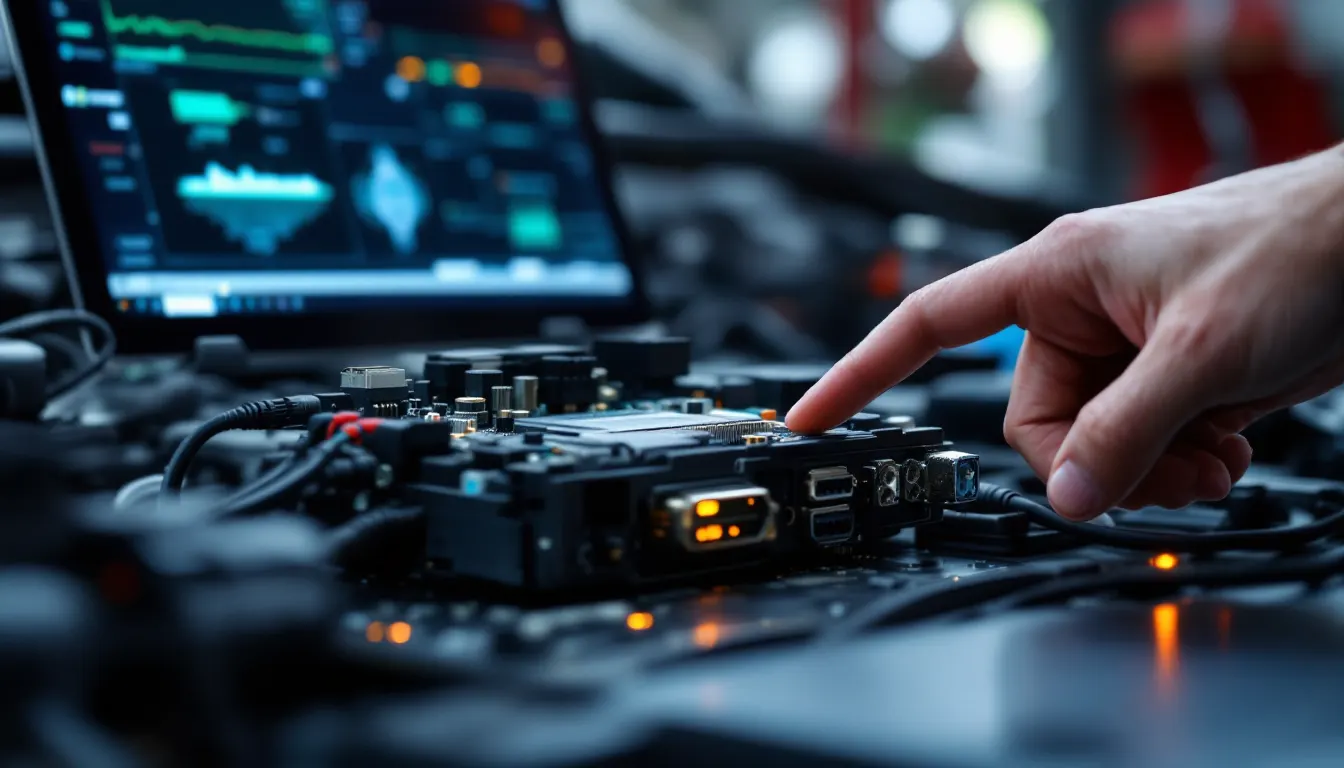
Modern vehicles are essentially computer networks on wheels, and the Engine Control Unit (ECU) — also called the Engine Control Module (ECM) or Powertrain Control Module (PCM) depending on the manufacturer — is the central brain of that network. When the ECU fails, gets water-damaged, or has to be swapped between vehicles, the new module must be programmed and adapted to the specific vehicle before the engine will run, start reliably, or pass emissions testing.
This 2026 guide explains what ECU/ECM/PCM programming actually involves, when a Fort Worth vehicle owner needs it, how the work happens in your driveway, and what fair pricing looks like compared to dealership rates. Whether you drive a 2010 F-150 in Fort Worth, a 2018 Camry in Arlington, or a 2024 BMW X5 in Dallas, the platform context below covers the cost questions. Our ECU programming service handles booking, but the technical detail below explains why the work costs what it costs.
What an ECU Actually Does
The ECU is a sealed microprocessor module — usually mounted in the engine bay or under the dash — that runs the manufacturer’s engine management firmware. It reads inputs from dozens of sensors (mass airflow, oxygen, coolant temperature, throttle position, knock, camshaft and crankshaft position, transmission speed) thousands of times per second, and controls outputs that determine how the engine runs: fuel injector pulse width, ignition timing, variable valve lift and timing, electronic throttle position, turbocharger boost pressure, emissions control devices, and on modern automatics, transmission shift logic.
Modern vehicles ship with 30 to 100+ separate electronic control modules — the BCM (Body Control Module), TCM (Transmission Control Module), ABS module, airbag SRS module, instrument cluster, infotainment head unit, telematics, climate control, each door, the steering column, and on luxury vehicles, individual modules for seats, mirrors, and adaptive headlights. The ECU is the most critical of the bunch because nothing else matters if the engine won’t start. It’s also the module most commonly requiring programming work after failure or replacement.
When You Actually Need ECU Programming
Replacement After Water or Electrical Damage
Fort Worth’s thunderstorm season produces a steady stream of water-damaged ECUs every summer — a vehicle parked in a flooded street, a leaky cowl drain, or a sealed engine-bay enclosure that traps moisture. A water-damaged ECU typically presents as no-start, intermittent stall, random sensor faults, or a cluster full of warning lights with no consistent code pattern. The fix is replacement, but the replacement module must be programmed with the vehicle’s specific VIN, mileage, calibration file, immobilizer pairing, and any optional-equipment coding before it’ll run.
Used ECU from a Donor Vehicle
A common cost-saving move: pulling a working ECU from a salvage-yard donor vehicle and installing it in your own car. The catch is that the donor ECU has its previous vehicle’s VIN, mileage, and immobilizer pairing burned in. To work in your vehicle, the donor module has to be re-flashed with your VIN, your mileage data, your immobilizer codes, and any platform-specific calibration deltas. Some manufacturers (GM, Toyota, Honda) allow this with the right tool; others (Mercedes, BMW post-CAS3, Audi post-2009) lock the module to its original VIN and require either bench-level EEPROM work or an online security gateway authorization to re-VIN.
Immobilizer Fault Lockout
On some vehicles, repeated immobilizer authentication failures cause the ECU to enter a permanent lockout state requiring a programming session to clear. Common on older Audi, VW, and BMW platforms after attempted keyless-entry hacks or improper key programming attempts. The fix is to connect a diagnostic tool, read the immobilizer adaptation channels, clear the lockout flags, and re-pair the existing keys.
Calibration Update or TSB Reflash
Manufacturers issue Technical Service Bulletins (TSBs) recommending or requiring ECU firmware updates for specific issues — rough idle, transmission shudder, emissions-related driveability complaints. The dealership performs these reflashes under warranty when applicable; out of warranty, an independent ECU programming specialist can perform the same reflash using the manufacturer’s service tool or an equivalent professional aftermarket tool (Autel MaxiSys Elite, Snap-on Modis Edge, Bosch ADS 625x). The current calibration files are publicly available for most domestic platforms through NASTF or directly from the OEM’s service-information portal.
Performance or Emissions Tuning
Aftermarket ECU tuning — commonly “custom flashing” or “remapping” on diesel and turbocharged platforms — is a separate specialty that overlaps with programming but raises emissions-regulation concerns. EPA Clean Air Act compliance prohibits flashes that defeat or remove factory emissions controls; a legitimate tuner explicitly identifies what gets changed and confirms compliance with Texas Department of State Health Services emissions inspection rules.
Are Factory Auto Control Modules Plug-and-Play?
Almost never — and this is the question that costs vehicle owners the most money, so it is worth answering flatly.
A factory replacement module arrives as a blank component wearing the correct part number. It does not carry your vehicle's calibration, it does not carry your VIN, and on security-relevant modules it does not carry your immobilizer data. Physically it drops straight in. Electronically it is a stranger on your car's network, and the network treats it as one.
There are three narrow exceptions worth naming, because they are the source of the myth:
Some simple body-side and comfort modules self-configure. A handful of low-level modules read what they need from the network on first power-up and require nothing from a tool.
Some parts are pre-programmed before shipping. A supplier who takes your VIN at order time and writes it before the box leaves the warehouse is doing the programming — just somewhere else. That is programming performed in advance, not programming avoided, and the listing wording rarely makes the distinction clear.
Some modules only need configuration, not a full flash. Faster and cheaper than a calibration write, but still a tool session at the vehicle.
Everything else — engine, transmission, body, gateway, instrument cluster, restraint, and receiver modules — needs a real programming session. If you have already installed a module and the vehicle has not improved, our diagnostic walkthrough for a new module installed and the car still not starting covers the ladder for working out which step was missed.
As of August 2026, the single most reliable way to avoid this problem is to ask before buying rather than after installing. Send the VIN and the part number you are considering and find out whether the platform accepts that part, and whether it will need a flash, a configuration, a re-VIN, or a security match. It is a five-minute question that routinely saves several hundred dollars.
How ECU Programming Happens in Your Driveway
A mobile ECU programming specialist arrives with a diagnostic tool (Autel MaxiSys Ultra, Snap-on Solus Edge, Bosch ADS 625x, or platform-specific OEM tools like Ford IDS, GM MDI2, Mercedes Xentry), an internet connection (most modern reflashes require live OEM server authorization), and a high-amperage bench power supply (50–70 amps minimum — many reflashes will brick the module if voltage drops below 12.5V mid-flash).
The workflow: connect the tool to the OBD-II port, identify the vehicle and module, request the current calibration file from the OEM server (or load it from the locksmith’s licensed software library), initiate the flash, monitor progress on the tool screen for 15–45 minutes depending on file size, verify the flash completed cleanly with a fresh DTC scan, and clear any post-flash adaptation codes. On vehicles with online security gateway requirements (most 2018+ FCA/Stellantis, VW Group, GM SGM platforms), the tool also has to complete a real-time security authorization through the OEM gateway — an additional 5–15 minutes.
DFW 2026 Pricing: Mobile vs Dealer ECU Programming
| Service | Mobile specialist | Dealership | Notes |
|---|---|---|---|
| New ECU programming (domestic) | $275–$475 | $525–$900 | Plus module cost |
| Used ECU re-VIN (domestic/Asian) | $325–$500 | Often refused | Some platforms only |
| Used ECU re-VIN (European) | $500–$1,200 | Often refused | EEPROM bench work |
| TSB reflash / calibration update | $175–$325 | $350–$525 | No charge in warranty |
| Immobilizer lockout clearance | $175–$325 | $325–$575 | Platform-dependent |
| BCM / PCM combo programming | $425–$725 | $725–$1,400 | Multi-module sequence |
Two pricing notes. First: a used-ECU re-VIN is something most dealerships refuse to perform at all — they’ll only program brand-new modules sold through their parts counter. A mobile ECU specialist who has the right bench tools (Autel IM608, AVDI, Smart Pro, Lonsdor K518) can re-VIN salvage-yard modules on many platforms, saving the customer the $400–$1,200 cost of a new OEM module. Second: a dealership ECU programming job typically bills 2–3 hours of bay labor at $185–$260/hr in DFW, plus the module cost, plus a per-flash software access fee. Mobile pricing is flat-rate and excludes the bay labor entirely.
Pricing reviewed 28 August 2026. The ranges above still hold across DFW. If you are specifically pricing a salvage-yard module rather than a new one, our dedicated used module programming cost guide breaks the same work out by module type — engine, transmission, body, cluster — and covers the platform check that decides whether a used part saves you anything at all.
One recent job worth describing, because it is representative. A customer brought us a truck with a replacement engine module already fitted by someone else and a no-start that nobody could explain. The module was correct, the installation was clean, and the flash had been performed — but the configuration step afterward had been skipped, so the vehicle and the module disagreed about what the truck was. The fix was configuration and a relearn, not another module. That sequence — right part, incomplete programming, expensive misdiagnosis — is the single most common way people end up paying twice. It is not limited to engine modules either; infotainment units land here constantly, which is why we wrote up Ford SYNC APIM module programming separately.
A more recent one, this month: a GM truck came in as "the computer is bad" because both key fobs had stopped working and the tire pressure display had gone blank. The engine module was fine. Both symptoms shared a single failed keyless entry receiver, which is exactly the sort of two-systems-one-part pattern that gets misread as an ECU fault — we wrote that case up as the GM RCDLR keyless entry receiver guide. Before assuming the engine module, it is worth confirming the symptom actually belongs to it.
Why ECU Programming Requires Specialized Equipment
Three things distinguish ECU programming work from regular OBD-II scan-tool diagnostics. First: a regular code reader (Autel AL319, Innova 3160, Bosch OBD 1300) can only read stored DTCs and live data — it has no programming capability. A full programming-capable tool (Autel MaxiSys Ultra, Snap-on Modis Edge, Bosch ADS 625x) is a $4,000–$15,000 investment with software subscriptions running $1,200–$3,500/year per OEM coverage.
Second: most modern reflashes require live internet connection to the OEM’s programming server (Ford SDRM, GM SGM, Stellantis SGW, BMW ISTA-P, Mercedes Xentry) for the calibration file and the security access token. A locksmith or technician without those credentials can’t complete the flash even with the right hardware. NASTF Secure Data Release is the credentialing system for independent specialists to legally access these OEM gateways.
Third: voltage stability during the flash is critical. A typical ECU flash takes 15–45 minutes during which the module is in a vulnerable bootloader state. If battery voltage drops below 12.5V (which can happen during long crank attempts or with weak batteries), the flash can corrupt the module’s firmware permanently — turning a programmable module into a paperweight. A 70-amp bench power supply on the vehicle’s battery terminals is standard practice for any reflash longer than 5 minutes.
What an Experienced Mobile ECU Specialist Says
“The big misconception about ECU work is that it’s ‘just plugging in a scanner.’ A full programming-capable tool that covers the major OEMs costs $8,000–$15,000 and the annual software subscriptions run another $4,000–$8,000 if you want current calibration files across Ford, GM, Stellantis, Toyota, Honda, VW Group, and BMW/Mercedes. Plus you need a 70-amp bench supply on the battery, NASTF credentials for the security gateways, and platform-specific bench-tools for the EEPROM jobs that the OBD route can’t handle. That’s why the dealership prices what it does, and why a real mobile specialist can come in below that — we’re not paying the dealer’s bay overhead, but we’re absolutely paying for the same tools.”
— ALOA-MAL-certified mobile locksmith with ECU programming specialty, NASTF VSP, 10 years in DFW
Credential verification: the Associated Locksmiths of America publishes a public directory of Master Automotive Locksmiths, and the National Automotive Service Task Force tracks active Vehicle Security Professional registrations including OEM gateway authorizations.
Common ECU-Related Failure Modes in Fort Worth
Water Intrusion (2008–2015 GM Trucks Especially)
The ECU on 2008–2015 Silverado, Sierra, Tahoe, Suburban, and Yukon platforms is mounted in a particularly vulnerable spot near the cowl drain. Clogged cowl drains in heavy DFW thunderstorm season let water pool against the module connector, causing intermittent stalls, random codes, and eventual hard failure. The repair is a replacement ECU (often a salvage-yard donor re-VIN’d at $400–$650 instead of a new-from-GM module at $900–$1,300) plus cowl-drain cleaning. Avoid by clearing the cowl drains twice a year.
Cracked Solder Joints (BMW DDE, Mercedes ECM)
Older European diesel and gas ECUs (BMW DDE 5.0/6.0 on E46 and E60, Mercedes ECM on W203 and W211) commonly develop cracked solder joints on the main microprocessor after 100,000+ miles of heat cycling. Presents as intermittent no-start, random misfire codes, or sudden stall. A bench-level reflow repair by a specialist runs $250–$425 versus $1,200–$2,000 for a new module from the dealer.
Failed Reflash, Module Bricked
Happens when a DIYer attempts an ECU flash with a cheap eBay tool and voltage drops mid-flash, or when a shop attempts a flash without checking battery condition first. The module becomes unresponsive on OBD-II and won’t boot. Recovery requires bench-level work — pulling the module, accessing the bootloader directly, and re-flashing the firmware from a known-good image. Specialist work, $325–$650 typically.
What to Do Right Now
If your vehicle has random electrical faults, intermittent stalls, or a no-start after a water exposure event, get the ECU diagnosed before assuming worst-case replacement — sometimes a corroded connector or cracked solder joint is repairable at a fraction of replacement cost. If you’re sourcing a used ECU from a salvage yard, ask the mobile programmer whether re-VIN is supported on your platform before paying for the module — some platforms (Mercedes 2009+, BMW CAS4+, Audi 2009+) effectively block used-ECU re-VIN without bench-level EEPROM work. If your dealership quoted $1,400+ for an ECU job, get a second opinion from a mobile ECU programming specialist — the savings on real-world DFW jobs typically run 40–60%.
Frequently Asked Questions
Can a regular shop or quick-lube reprogram my ECU?
No. Quick-lube shops, oil-change centers, and most general-repair shops don’t carry the $8,000–$15,000 programming-capable tools, the OEM software subscriptions, or the NASTF credentials required for the security gateways. ECU programming is a specialist service.
Does NASTF Secure Data Release work for ECU programming, or just keys?
Both. NASTF SDRM gates security-sensitive operations on modern vehicles including key programming, ECU re-VIN, immobilizer adaptation, and protected calibration access. The registry is the same one used for automotive locksmith credentialing.
Is custom “performance tuning” legal?
It depends on what gets changed. Tunes that preserve all factory emissions controls and OBD-II monitoring (cosmetic timing, fuel trim, shift-firmness adjustments) are typically legal. Tunes that delete catalytic converter monitors, EGR systems, or particulate filters violate EPA Clean Air Act §203 and can fail Texas emissions inspection. A legitimate tuner discloses what gets changed before any work happens.
Will an aftermarket reflash void my factory warranty?
Federal Magnuson-Moss Warranty Act protections mean a dealership can’t void your warranty solely because aftermarket programming was performed — they have to prove the aftermarket work caused the specific failure being claimed. In practice, dealers frequently deny warranty claims on tuned vehicles, and recovering through arbitration is a multi-month process. Worth weighing before flashing a vehicle still under warranty.
Service Throughout Fort Worth and the DFW Metroplex
Mobile ECU, ECM, PCM, BCM, and TCM programming is available throughout Fort Worth, Arlington, Dallas, Irving, Plano, and Frisco. Common Fort Worth service zones include Alliance Town Center, the North Tarrant Parkway corridor, Camp Bowie Boulevard, the TCU area, the Stockyards, the Cultural District, and Sundance Square. Outer-county addresses in Burleson, Mansfield, Aledo, Weatherford, and Granbury are covered with extended dispatch times.
For mobile ECU programming and automotive computer services throughout the Fort Worth area, contact Fort Worth Locksmith & Computer Programming at (817) 668-3801. We carry programming-capable tools (Autel MaxiSys Elite, AVDI, Smart Pro) with current OEM subscriptions and provide module programming across Ford, GM, Stellantis, Toyota, Honda, VW Group, BMW, and Mercedes platforms.
Sources & references
- NASTF Vehicle Security Professional registry — OEM gateway authorizations
- Associated Locksmiths of America — Master Automotive Locksmith directory
- EPA — Clean Air Act §203 aftermarket defeat device guidance
- NHTSA — vehicle recalls & ECU-related TSBs
- Federal Trade Commission — locksmith scam guidance
- U.S. Bureau of Labor Statistics — automotive service technician occupational data