Transponder Key Programming — The Complete 2025 Guide
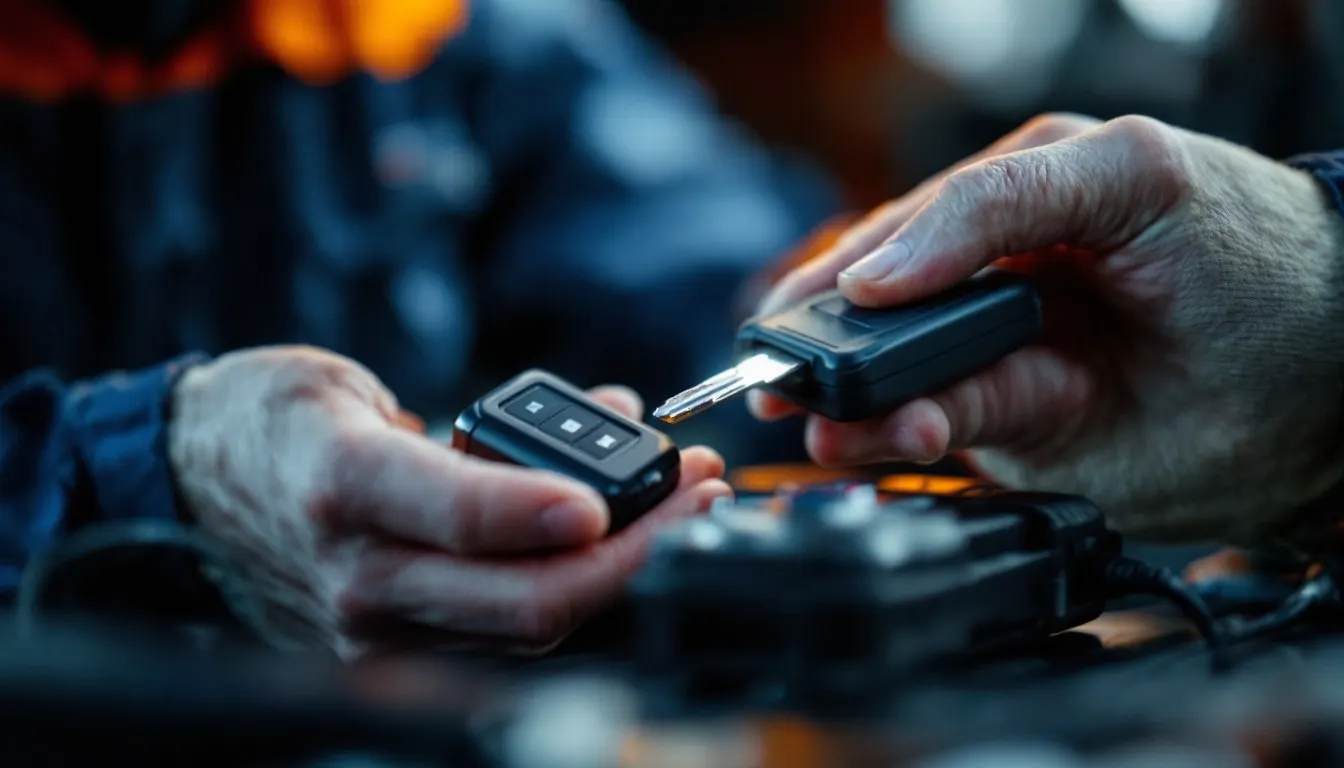
Transponder keys have been the automotive security standard for nearly thirty years, yet most Fort Worth drivers only discover how they work the day a hardware-store key copy fails to crank the engine. If your vehicle was manufactured after 1995, it almost certainly uses a transponder chip key tied to a factory immobilizer — and any replacement has to be cut AND electronically paired to the car before it will start.
This 2025 guide explains the technology behind transponder keys, why pairing matters, what realistic programming pricing looks like across Fort Worth, Arlington, Dallas, and the rest of the DFW area, and how to avoid the bait-and-switch pricing patterns the Federal Trade Commission has flagged in the locksmith industry. The link to professional transponder key programming on our service menu walks through pricing live, but the context below explains why the work costs what it costs.
What a Transponder Key Actually Is
“Transponder” is a contraction of transmitter and responder. Inside the plastic head of your key is a tiny passive RFID chip — about the size of a grain of rice — with no battery of its own. When you insert the key into the ignition cylinder (or hold it near the start button on push-to-start cars), an antenna ring around the cylinder broadcasts a low-power radio signal at roughly 125 kHz. That signal energizes the chip, which then transmits back a unique identifier encrypted to your vehicle.
Your car’s immobilizer module reads that ID, compares it to the list of authorized keys stored in non-volatile memory, and either releases the fuel injectors and starter circuit (engine cranks and runs) or holds them in cutoff (engine cranks for one second and dies, or simply refuses to crank). Every modern factory immobilizer uses some variation of this challenge-response handshake, with the implementation differing across platforms: Toyota uses Texas Crypto DST chips and the more recent DST-AES family, Ford uses PATS, GM uses Passlock and the later HitagAES platform, and the European brands use proprietary FBS, CAS, FEM/BDC, or EWS architectures depending on year and model.
The reason this matters to a Fort Worth driver: cutting a key blade to match your lock pattern is mechanical work that any sharp 1990s key machine can do. But matching the chip to your immobilizer requires diagnostic equipment, dealer or NASTF-issued security access for newer vehicles, and a technician who knows the platform. Without that programming step, the freshly cut key turns the cylinder, the starter cranks, and the engine immediately dies — exactly the failure mode that sends people back to the dealership wondering what went wrong.
How Programming Works in the Driveway
A mobile automotive locksmith arrives, plugs an OBD-II diagnostic tool into the port under the dashboard, and selects your vehicle’s exact year, make, and model. The tool then talks to the immobilizer module using one of three approaches depending on the platform: pin-code entry (older Ford, Mazda, and some Chrysler vehicles where a four- or six-digit code authorizes new keys), online security gateway authentication (most 2018+ vehicles, especially FCA, VW Group, and newer GM, which require a real-time authorization request to the manufacturer’s servers), or EEPROM bench programming (older European platforms and any vehicle where the immobilizer is locked out of diagnostic access).
For the most common case — a Honda Civic, Toyota Camry, or Nissan Altima with one working key in hand and a need for a spare — the entire pairing takes 10 to 20 minutes once the locksmith arrives. The tool initiates an “add key” sequence, the new transponder is held in the ignition or proximity zone, and the immobilizer writes the new key’s ID into its authorized list. Test, verify the engine starts and runs, done.
All-keys-lost is the harder case. With no working key in hand, the locksmith has to either pull a pin code from the vehicle’s computer (older platforms), generate one via NASTF Secure Data Release (newer platforms — the National Automotive Service Task Force runs the registry that gives credentialed locksmiths legal access to manufacturer security data), or pull the immobilizer module and read the EEPROM directly on a bench tool. That’s why all-keys-lost pricing is $100–$300 higher than spare-key pricing on the same vehicle — the labor and the equipment investment are both higher.
DFW Transponder Key Pricing in 2026
These are the realistic 2026 ranges for transponder key work in the Fort Worth and DFW market, based on what mobile locksmiths actually charge and what dealerships quote for the same procedures. Pricing varies by exact vehicle, but the bands hold up across most makes:
| Key type | Mobile locksmith (cut + program) | Dealership (parts + labor) | Savings |
|---|---|---|---|
| Basic transponder (1996–2010 domestic/Asian) | $150–$225 | $300–$450 | $150–$225 |
| Remote-head transponder (2008–2015) | $200–$300 | $350–$525 | $150–$225 |
| Smart proximity key (push-to-start) | $275–$425 | $475–$725 | $200–$300 |
| European luxury (BMW, Mercedes, Audi, VW, Porsche) | $400–$850 | $700–$1,400 | $300–$550 |
| All-keys-lost surcharge (any platform) | +$75–$200 | +$150–$400 (+ tow) | $75–$300 |
Two patterns to notice. First: the dealership price almost always includes a tow line if you have no working key, because dealerships do not dispatch mobile programming techs — your car has to come to them. A flat-bed tow inside Tarrant County adds $100–$200 depending on distance. A mobile locksmith eliminates that cost entirely. Second: the savings band widens dramatically on European platforms, because dealership labor rates in DFW for brands like BMW, Mercedes, and Audi run $185–$260 per hour, while a mobile locksmith with the same diagnostic equipment is billing the procedure flat-rate from the truck.
What an Experienced Automotive Locksmith Says About the Process
“Most of the public still thinks of locksmith work as pin tumbler stuff, but on the automotive side, 80–90% of what we do every day is electronic. A transponder pairing on a 2018 Toyota Camry isn’t mechanical labor — it’s reading the immobilizer, authorizing a new key through the proper security gateway, and verifying the start. If a shop is charging you $80 for a transponder pair, they’re either subsidizing the call or about to bait-and-switch when they arrive.”
— ALOA-certified Master Automotive Locksmith (MAL), NASTF Vehicle Security Professional, DFW-area mobile technician
Credential verification is straightforward. The Associated Locksmiths of America maintains a public directory of certified members, including the Master Automotive Locksmith (MAL) credential that requires demonstrated programming competency across multiple platforms. The National Automotive Service Task Force runs the Secure Data Release Model registry that gives locksmiths legal, audited access to manufacturer security data for newer vehicles. Both directories are free to search.
Common Transponder Problems in Fort Worth Vehicles
Engine Cranks for One Second, Then Dies
Classic immobilizer fault. The starter and fuel pump get a brief authorization while the immobilizer reads the chip, but when the chip ID doesn’t match (or the chip is dead), the engine cuts fuel and spark within about a second. Often caused by a worn or damaged transponder chip in an old key, a key with a cracked head where the chip has shifted out of position, or a degraded antenna ring inside the steering column. Hardware-store key copies that were never properly programmed produce this exact symptom every time.
Immobilizer Warning Light Stays On With Engine Running
The dashboard key icon or “security” warning should extinguish within a couple seconds of engine start. If it stays illuminated, the immobilizer module is logging a fault — usually intermittent chip reads, a weak antenna ring, or a stored DTC that needs to be cleared after a battery disconnect. Don’t ignore this one; it often precedes a no-start failure within days or weeks.
New Key Won’t Pair, Vehicle Locks Out for 10+ Minutes
Many factory immobilizers (Honda, Toyota, Nissan especially) enforce a programming attempt timeout. After three or four failed pairing attempts in quick succession, the security system locks out for 10 minutes — or in some cases 30 minutes — before another attempt can be made. This is a deliberate anti-theft measure, not a malfunction. A trained locksmith waits out the lockout window and tries again with corrected programming sequence.
Remote Buttons Work But Engine Won’t Start
Remote door functions use a separate transmitter inside the fob, powered by the fob’s coin cell battery. The transponder chip that authorizes engine start is a separate, batteryless RFID component. So a fob can lock and unlock the doors perfectly while completely failing to start the engine. Usually means the chip itself has failed, the chip has come loose inside the fob housing, or the antenna ring around the ignition has stopped reading. All three are diagnosable in under 15 minutes by a mobile locksmith with a chip reader.
Avoiding the “$19 Transponder Key” Scam
The Federal Trade Commission has published guidance on a recurring scam pattern in the locksmith industry: low-ball phone quotes ($19 to $49) that balloon to $250 or more on arrival, with the unmarked technician threatening to leave the customer stranded if they don’t pay. The pattern shows up most aggressively on Google Maps results for “locksmith near me” and on lead-generation websites that aggregate calls to bidder networks.
Real transponder programming work in DFW does not cost $19. The wholesale cost of a quality transponder chip and a precut key blank alone is typically $35–$80 to the locksmith before any labor. Anyone quoting under $100 for cut + program is either misrepresenting the service to get in the door, or about to deliver a non-functioning hardware-store copy and walk away. Always insist on a written, all-in quote that includes parts, labor, and programming, before any work begins.
What to Do Right Now
If you still have one working key, get a spare cut and programmed now — spare-key pricing is $100–$300 cheaper than all-keys-lost pricing on the same vehicle. If you’ve already lost all keys, don’t tow the car to the dealership; call a NASTF-registered mobile locksmith who can come to your location, decode the immobilizer, and pair new keys on-site. If your engine cranks but won’t stay running, or the immobilizer light stays on, get it diagnosed before the failure becomes a no-start in a parking lot. Mobile transponder key programming service in Fort Worth typically dispatches within 25–45 minutes inside the urban core and 60–90 minutes for outer-county addresses.
Frequently Asked Questions
Can I program a transponder key myself?
On a small number of older vehicles (some 1990s and early 2000s Ford and Chrysler models), an “on-board programming” sequence exists that lets the owner pair a new key by cycling the ignition with two existing working keys present. For everything from the mid-2000s onward, no — you need diagnostic equipment, often a dealer or NASTF security authorization, and a known-good chip programmed to the correct platform. There’s no consumer-grade tool for this work on modern vehicles.
Will a hardware-store key work as a backup?
Only mechanically. A hardware-store cut on a non-chipped blank will turn the ignition cylinder and unlock the doors, but it will not start the engine because there’s no transponder chip for the immobilizer to authorize. This is genuinely useful as an emergency door-unlock backup if you lock your keys in the car, but it’s not a substitute for a programmed spare.
Why does my dealership quote include a “security access fee”?
Manufacturer security gateways (Stellantis SGW, Ford FordPass, GM SGM, VW Group Online ServiceNet) charge per-transaction fees for security data access on newer vehicles. The fee is real and the locksmith pays it too — it’s typically baked into the flat-rate price rather than itemized.
How long does the average pairing take in my driveway?
With one working key present: typically 15–30 minutes from arrival to verified engine start, including key cutting. All-keys-lost: 45–90 minutes depending on platform and whether bench programming is required. European luxury all-keys-lost on FBS3/FBS4 or CAS4/FEM/BDC platforms can run 90–150 minutes.
Service Throughout Fort Worth and the DFW Metroplex
Mobile transponder key programming is available throughout Fort Worth, Arlington, Dallas, Irving, Plano, and Frisco, with same-day appointments most of the year and 24/7 emergency dispatch for lockouts and all-keys-lost situations. Common service zones include the TCU area, Camp Bowie Boulevard, Sundance Square downtown, the Stockyards, Alliance Town Center, and the North Tarrant Parkway corridor through Keller and North Richland Hills.
For professional transponder key programming throughout Fort Worth and the DFW area, contact Fort Worth Locksmith & Computer Programming at (817) 668-3801. We specialize in all vehicle makes and models with mobile service that comes directly to your location.
Sources & references
- Associated Locksmiths of America — certification directory
- NASTF Vehicle Security Professional registry & Secure Data Release Model
- Federal Trade Commission — locksmith scam guidance
- NHTSA — vehicle anti-theft system requirements (FMVSS 114)
- U.S. Bureau of Labor Statistics — locksmith occupational data (SOC 49-9094)
- Texas DPS Private Security Bureau