Automotive Key Programming Near Me — Transponder, Smart Key & All-Keys-Lost (DFW)
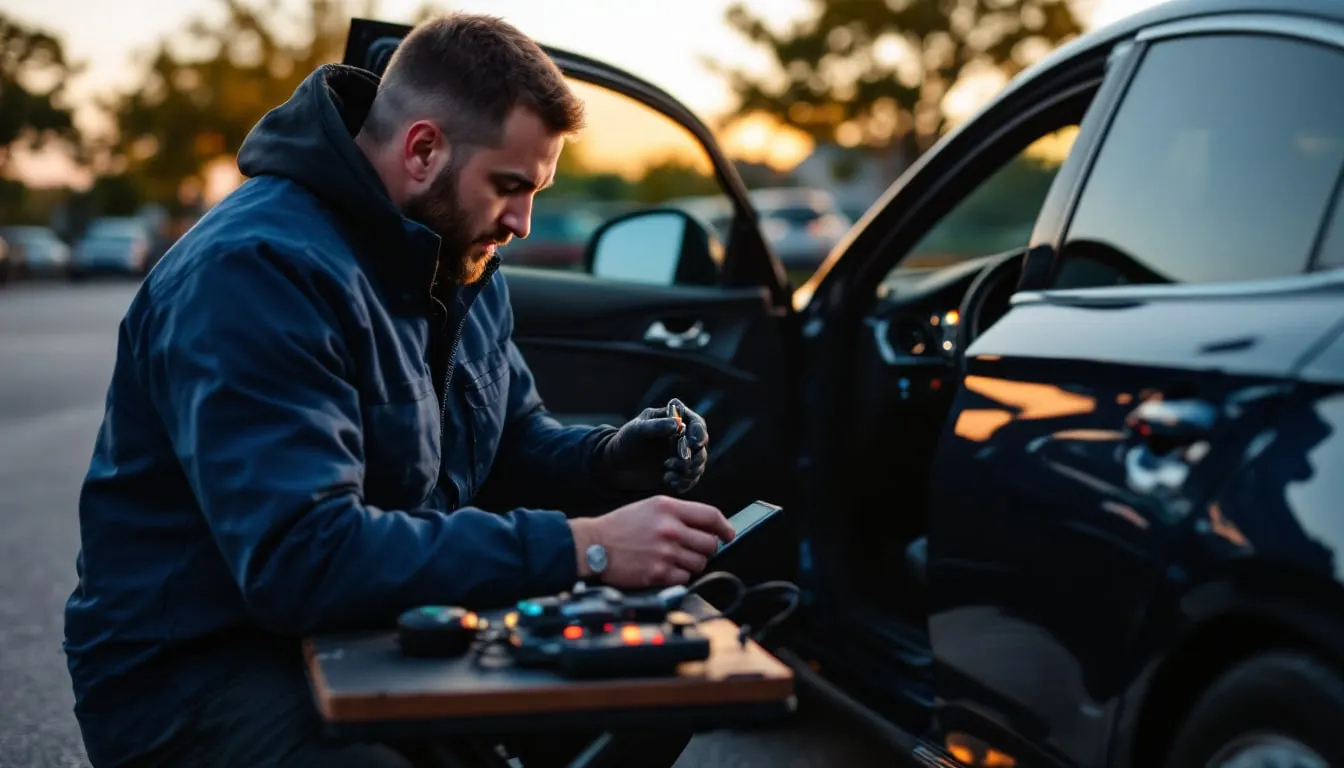
If you are searching “auto key programming near me” or “key programmer near me” in the Fort Worth area, you have probably already discovered the hard truth of modern car keys: cutting a blade is the easy part. Since the mid-1990s, virtually every car key also has to be electronically programmed to your vehicle’s immobilizer before the engine will start — and a key that is not programmed is just an expensive piece of metal and plastic. This guide explains the four key types, what programming each one involves, the difference between adding a key and an all-keys-lost job, and how mobile service gets it done in your driveway.
The whole point of a “near me” search is that you want someone to come to you — at home, at work, or stranded in a parking lot — rather than tow the car to a dealership. A qualified mobile automotive locksmith does exactly that, usually for 30–50% less than dealer pricing. For costs in detail, pair this with our car key replacement cost guide.
Why Modern Keys Must Be Programmed
The reason key programming exists is theft prevention, and it works. After immobilizers became common, vehicle theft of equipped cars dropped sharply — a trend documented in decades of NHTSA vehicle theft prevention data and reinforced by federal anti-theft standards under 49 CFR Part 541. An immobilizer means the vehicle’s computer checks for a matching encrypted signal from the key before it will let the engine run. No matching signal, no start — even if the blade turns the ignition perfectly.
That security is also why a hardware-store key copy will not start your car, and why a real provider needs legitimate access to your vehicle’s security data. Per the NASTF Vehicle Security Professional registry, an identity-verified VSP can obtain the same key codes and security access a dealer technician uses — the credential that lets an independent locksmith program keys, including on locked-down newer platforms, without sending you to the dealer.
The Four Key Types — and What Programming Each One Takes
1. Transponder (chip) keys. A microchip in the plastic head sends an encrypted code to the immobilizer. The key must be cut to the lock AND have its chip programmed to the car. Standard on most vehicles from the mid-1990s through the 2010s. Programming usually takes 15–30 minutes once a working key exists. See our transponder key programming service.
2. Remote head keys. A transponder key with the remote lock/unlock buttons built into the head. These need three procedures: blade cutting, chip programming, and remote synchronization to the vehicle’s receiver. Common on vehicles from the late 2000s into the mid-2010s.
3. Smart / proximity keys (push-button start). If your car starts with a button, you have a smart key. It uses encrypted rolling codes and short-range RF so the car recognizes the fob without you touching it. Programming requires manufacturer-specific equipment and is the most involved of the everyday key types — but a properly equipped mobile locksmith handles it on site.
4. Mechanical (non-chip) keys. Increasingly rare, found on vehicles before the mid-1990s and a few economy models into the early 2000s. These only need cutting — no electronic programming — and are the cheapest to replace.
Adding a Key vs. All Keys Lost
This single distinction drives most of the price difference in key programming, so it is worth understanding before you call:
Adding a spare (you still have a working key): The simplest, fastest, cheapest scenario. With a working key present, the locksmith can usually add an additional key quickly through the OBD port. This is why getting a spare made proactively is the best money-saving move in this entire category — it converts a future emergency into a routine appointment.
All keys lost (no working key): Harder. With no key to start from, the locksmith must extract security data from the vehicle — sometimes reading it directly from a module — before any new key can be programmed. All-keys-lost jobs take longer, require more advanced tooling, and cost more, especially on European platforms where the work may involve bench programming of a module. Our EEPROM all-keys-lost guide covers the deep end of this work.
“The biggest pricing mistake consumers make is assuming a dealership quote is the ‘official’ price. There is no official price — there is only labor, software access, and the part. A NASTF-registered mobile locksmith pays the same module-licensing fees the dealer does, but does not bake in the cost of a service-bay appointment or a tow. Get two written quotes before you authorize any work, especially on an all-keys-lost.”
— Mary May, Executive Director, Associated Locksmiths of America (ALOA)
ALOA sets professional standards for the trade. Per ALOA, qualified automotive locksmiths should provide VIN-based written quotes before dispatch and carry current diagnostic-tool licensing — two things to confirm before anyone starts cutting or programming.
How Mobile Key Programming Works at Your Location
A mobile visit follows a consistent sequence. The locksmith verifies the vehicle and your proof of ownership, identifies the exact key type and chip family for your year and make, cuts the blade (mechanically or by code), connects programming equipment to the OBD port, programs the chip and — for smart keys — pairs the proximity fob and remote functions, then tests every function: start, lock, unlock, panic, and trunk or liftgate. For all-keys-lost, an extra security-extraction step comes first. The entire job is done where your car sits, which is the advantage of searching “near me” in the first place.
Key Programming Cost Near Fort Worth
Local 2026 ranges, mobile service included:
Transponder keys: $150–$250. Remote head keys: $175–$300. Smart / proximity keys (domestic and Japanese): $250–$400; European luxury smart keys run higher. Add $50–$150 for all-keys-lost, and a modest after-hours premium for nights and weekends. Dealerships typically charge 30–50% more for the same key, and require you to bring the car to them — often a $75–$200 tow if you have no working key. The U.S. Bureau of Labor Statistics tracks the trade under SOC 49-9094; its occupational data shows mobile locksmith capacity concentrated in metros like DFW, which is why same-day “near me” service is realistic here.
Those same ranges in one place, as of October 2026:
| Job | Mobile price, programming included |
|---|---|
| Transponder (chip) key | $150–$250 |
| Remote head key | $175–$300 |
| Smart / proximity key — domestic and Japanese | $250–$400 |
| Smart / proximity key — European luxury | Higher than the domestic and Japanese range |
| All keys lost (no working key) | Add $50–$150 to the above |
| Nights, weekends, holidays | Modest after-hours premium |
| Same key at a dealership | 30–50% more, plus a $75–$200 tow if you have no working key |
Key Programming on Newer Secure-Gateway Vehicles
A growing share of "key programming near me" calls involve vehicles where the diagnostic port no longer gives open access. GM's 2020-and-newer Global B trucks and SUVs, Stellantis vehicles behind the security gateway (most 2018-and-newer Chrysler, Dodge, Jeep and Ram), late-model Fords and the newest Nissan and Toyota platforms all require an authenticated session before a key can be added.
Two practical consequences. First, adding a spare on these platforms generally runs $250–$650+ rather than the older transponder figures, because the session itself is part of the cost. Second, all-keys-lost on these vehicles is quoted after diagnosis — the procedure depends on the exact VIN, and an honest provider tells you that before dispatch rather than after arrival.
It is still mobile work in most cases. Our guides to GM Global B key programming and the security gateway on Dodge, Ram and Jeep explain what the authorization step involves. For make-specific numbers see the Nissan key replacement cost guide, and for the cheapest way to avoid an all-keys-lost job entirely, the spare key cost guide.
What Actually Drives Your Key Programming Price
Two drivers of the same make can get different quotes, and the reasons are not arbitrary. Understanding them lets you read a quote intelligently:
Key type. A transponder key is cheaper than a remote head key, which is cheaper than a smart proximity key — each adds programming steps and a more expensive blank.
Whether you still have a working key. The single biggest swing. Adding a spare is quick; all-keys-lost adds a security-extraction step, more time, and on some platforms bench-level work.
Make and platform complexity. Domestic and Japanese keys are generally less expensive than European luxury keys, where the immobilizer architecture and licensing costs are higher.
OEM vs. aftermarket fob. A quality aftermarket fob can run 30–40% less than an OEM part and works identically on many vehicles; on some it is not appropriate, and a good locksmith tells you which.
Time and location. Nights, weekends, and holidays carry a modest after-hours premium, and a long drive to an outlying address may add a travel charge. None of these should be a surprise — they belong in the written quote you get before dispatch.
Avoiding Key-Programming Scams
Automotive key programming is a frequent target for bait-and-switch operators, and the Federal Trade Commission has documented the pattern: a suspiciously low phone quote, a non-local number, an unmarked vehicle, and a price that balloons once the technician is at your car and you feel stuck. Protect yourself with a few simple checks.
Insist on a written, all-in quote tied to your specific year, make, model, and key situation before anyone is dispatched — a real provider can give one. Be wary of a quote dramatically below every other quote; that gap is usually the setup for the upsell on arrival. Confirm the provider takes card, not cash only. And expect to show proof of ownership — a legitimate locksmith requires it, and one who waves it off is a red flag, not a convenience. These habits cost you nothing and screen out the operators the FTC warns about.
A Real-World Example
The situation: A driver in Arlington lost the only smart key to a 2019 Nissan Altima in a parking lot — a true all-keys-lost on a push-button-start vehicle.
Before: The dealer wanted the car towed in, quoted a multi-day wait for a VIN-ordered fob, and the out-the-door estimate with towing approached $600. The driver was stranded with no way to move the car.
The mobile visit: A locksmith came to the parking lot, verified ownership, performed the all-keys-lost security extraction, cut and programmed a new smart key, paired the proximity and remote functions, and recommended a second spare to avoid a repeat. Total time on site was under 90 minutes.
Result: The driver was back on the road the same hour, paid well under the dealer estimate, and left with a programmed spare so the next lost-key event would be a routine add rather than another all-keys-lost emergency. That spare is the cheapest insurance in this entire category.
Frequently Asked Questions
Can a locksmith program a key right at my location?
Yes. A mobile automotive locksmith carries cutting and programming equipment to your home, workplace, or wherever the car is stranded. Transponder, remote head, and smart keys can all be cut and programmed on site — that is exactly what a “near me” search should get you, with no tow required.
Why is all-keys-lost more expensive than getting a spare?
With no working key, the locksmith must first extract security data from the vehicle before any new key can be programmed — extra time, advanced tooling, and on some platforms bench-level work. Adding a spare while you still have a working key skips that step, which is why a proactive spare is the cheapest path.
How much does auto key programming cost near Fort Worth?
Transponder keys run $150–$250, remote head keys $175–$300, and smart keys $250–$400 for domestic and Japanese vehicles (European luxury higher), with mobile service included. Add $50–$150 for all-keys-lost. Dealerships typically charge 30–50% more and may require a tow.
Can a key be programmed for a push-button-start car?
Yes. Smart / proximity keys for push-button-start vehicles can be programmed by a locksmith with the correct manufacturer-specific equipment, including all-keys-lost situations. It is the most involved everyday key type, but a properly equipped mobile provider handles it at your location.
What proof do I need for mobile key programming?
Reputable locksmiths require proof of ownership — typically a government ID matching the vehicle registration or title — before programming a key, especially for all-keys-lost. This is a security feature that protects you, and a provider who skips it is one to avoid.
Get Auto Key Programming Near You in Fort Worth
Fort Worth Locksmith & Computer Programming provides mobile automotive key programming — transponder, remote head, smart key, and all-keys-lost — throughout Fort Worth, Arlington, Dallas, and the entire DFW metroplex. We come to you, verify ownership, quote in writing before we start, and program most keys in under an hour. For a true lockout, see our 24/7 emergency service.
Call (817) 668-3801 with your year, make, model, and whether you still have a working key. We will give you an upfront, all-in quote before we dispatch — same-day service for most makes across the Fort Worth area.