Battery Registration & BMS Coding: BMW, Mercedes, Audi (2026)
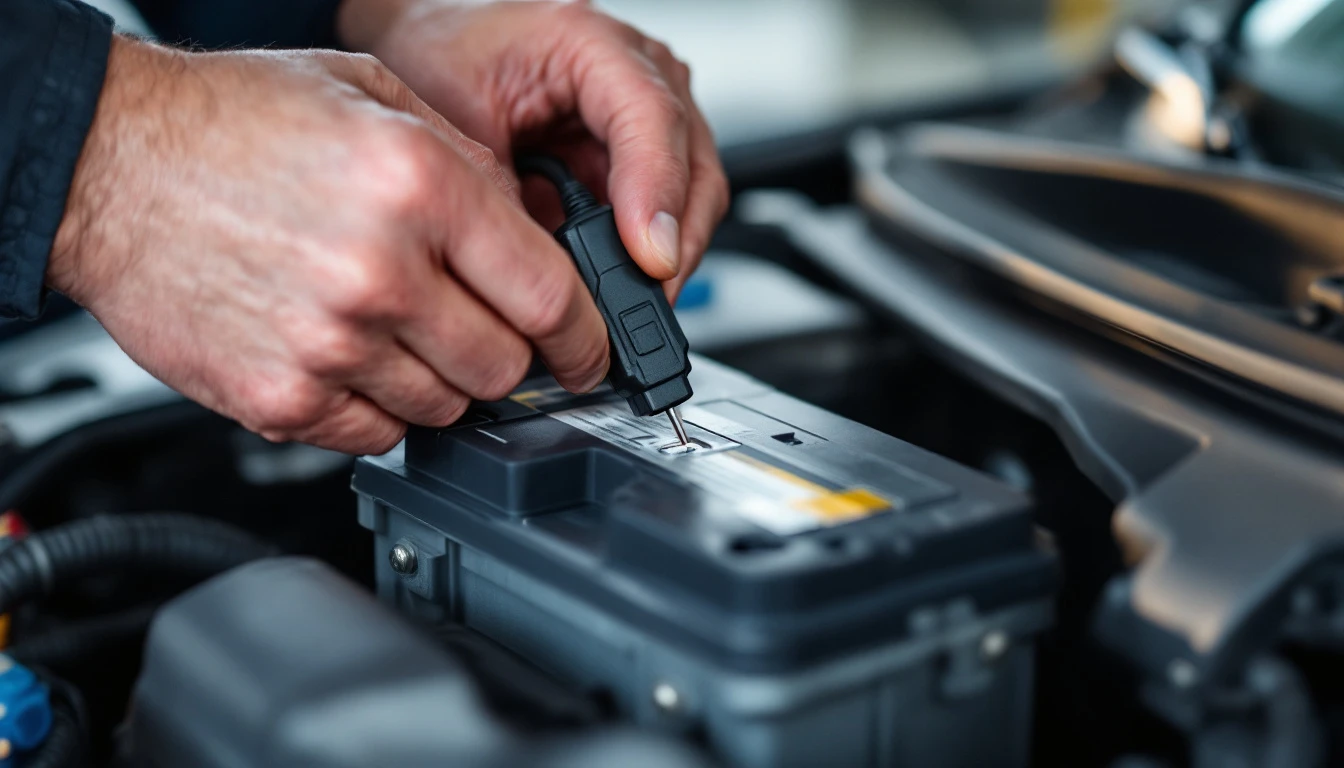
There is a category of European car complaint that arrives about six weeks after a battery replacement and sounds like an electrical gremlin. Stop-start quit working. The radio shuts off faster than it used to when the engine is off. A voltage code appeared. The new battery — bought new, installed correctly, tested fine at the parts counter — is already struggling.
Almost none of that is a defective battery. On most BMW, Mercedes-Benz, Audi and Volkswagen models built in the last twenty years, a battery is a coded component. The car has to be told a new one went in. When nobody performs that step, the vehicle keeps managing a battery that no longer exists.
The Battery Management System Is a Charging Strategy, Not a Gauge
It helps to stop thinking of the battery management system as a monitor and start thinking of it as a controller.
On an older car, the alternator's regulator held a more or less fixed output voltage whenever the engine ran. Charging was open-loop and indifferent — the battery got what it got. Modern European platforms replaced that with a closed loop. The vehicle measures what the battery is actually doing and adjusts the alternator's output moment to moment, deliberately over-charging on deceleration to recover braking energy, backing off under acceleration to reduce load on the engine, and holding a maintenance voltage the rest of the time.
To do that it needs data. On BMW the primary source is the IBS — the Intelligent Battery Sensor — a small module clamped onto the negative battery terminal. It is not a wire. It continuously measures current in and out, terminal voltage, and battery temperature, and reports a calculated state of charge and state of health onto the vehicle network. Mercedes, Audi and Volkswagen use equivalent sensing with their own hardware and their own naming.
From those measurements the car builds a long-running picture: how much capacity this battery still has, how fast it accepts charge, how deeply it has been cycled, how many times it has been drawn down overnight. That picture is what the charging strategy is calculated from, and it is what quietly governs whether the car is willing to run stop-start, how long it lets accessories run with the engine off, and how aggressively it sheds comfort loads when voltage sags.
Why That Picture Has to Be Reset
Here is the part that catches people out. The state-of-health picture is cumulative and persistent. It survives disconnecting the battery. It survives the replacement.
Swap in a brand-new battery without registering it, and the car does not notice. It has no way to detect a physical part change on its own; all it sees is the same terminal it has been watching for six years. So it keeps applying the strategy it had converged on for a four-year-old battery with reduced capacity and poor charge acceptance — typically a conservative regime that under-charges a healthy new battery, combined with load-shedding rules that assume very little reserve.
Registration is the deliberate act of saying: that history is void, start again. On most platforms the same routine also writes what the new battery is — its rated capacity in amp-hours and its chemistry.
BMW: Capacity and Chemistry, Both
BMW's registration routine records the nominal capacity of the battery you installed and its type. That second field matters more than owners realise, because BMW has shipped both conventional flooded lead-acid and AGM batteries across the range, and the correct charging behaviour for the two is genuinely different.
AGM cells tolerate — and generally want — a higher charge voltage and deeper cycling than a flooded battery. A flooded battery charged on an AGM profile is being pushed harder than it was built for, which shows up as gassing, elevated temperature and a shortened life. An AGM battery charged on a flooded profile is chronically under-charged, which drives sulfation and, again, a shortened life. Either mismatch produces the same customer-facing symptom: an expensive battery that dies young for no obvious reason.
Capacity matters for the same reason. Fitting a larger battery than the one coded gives the car a reserve figure it will not use; fitting a smaller one gives it a reserve figure it does not have. Both distort the stop-start decision and the load-shedding thresholds.
If the vehicle is in for other work anyway, this is worth grouping. Coding is coding, and a visit that already involves the diagnostic port — key work, module programming, or a transmission adaptation like a BMW EGS reset — is the cheap moment to get the battery registered as well. Cost context for BMW work generally is covered in our BMW key replacement cost breakdown for Arlington.
Mercedes-Benz: A Replacement Routine, and Sometimes Two Batteries
Mercedes handles the same problem through a battery replacement procedure in the factory-level diagnostic software. The mechanics differ from BMW's — the terminology is different, the menu path is different — but the purpose is identical: clear the accumulated management data and tell the car what is now installed.
Two Mercedes-specific things are worth knowing before the hood goes up.
First, many later models carry more than one battery. A main starter battery plus an auxiliary or backup battery is common on models with substantial electrical loads or stop-start systems, and the second battery is frequently somewhere unexpected — under a seat, behind a trim panel, in the trunk. A car that behaves oddly after a "battery replacement" sometimes had one of two batteries replaced. The second one is often the older one.
Second, on newer Mercedes platforms the coding side of the work has moved further behind the manufacturer's authenticated access. That is not unique to batteries — it is the same architectural direction that makes late-model key work its own conversation, which is why our guide to Mercedes E-Class and S-Class key replacement leans so heavily on identifying the exact platform first.
Audi and Volkswagen: The BEM Code
The Audi and Volkswagen approach is the most explicitly documented of the three, and the one owners can most easily verify themselves.
Group cars use a battery energy management entry, commonly called the BEM code. It is a string printed on a label on the battery itself, and it encodes the battery's identity — manufacturer, nominal capacity, and technology such as conventional flooded, EFB or AGM. When a battery is replaced, the new battery's code is entered into an adaptation channel in the vehicle's energy management side, and the old battery's data is retired.
This has a practical consequence: keep the label readable and photograph it before installation. Once the battery is in the tray and the terminals are on, that label is frequently facing a wall. It is a small thing that saves a second trip.
MQB-platform Audis and Volkswagens are also where component protection lives, which is a different mechanism entirely but frequently gets blamed for battery symptoms. Component protection governs whether a module is permitted to operate in this specific car; battery registration governs how the car charges. They are unrelated systems that both produce "I replaced a part and now something does not work" complaints. If your Audi's symptom set is closer to modules refusing to function than to charging behaviour, our write-up on Audi immobilizer repair and MQB component protection is the more useful read.
What Actually Goes Wrong When Registration Is Skipped
Grouping the symptoms is useful, because individually they look like unrelated faults.
Premature battery death. The most common and most expensive one. A new battery run for a year on the charging profile of a worn-out battery is either chronically under-charged or over-worked. Two-year lifespans on parts that should last five or six are the normal outcome, and the usual response is to blame the battery brand and buy another one — which then does the same thing.
Stop-start refuses to engage. The system only shuts the engine off when power management believes there is enough reserve to restart it and carry the load. Old state-of-health figures say there is not. The engine keeps running at every light, and the owner assumes the stop-start system broke.
Early comfort-feature shutdown. Load-shedding rules kick in earlier than they should, so the radio, seats or ventilation cut out sooner with the engine off.
Intermittent voltage-related codes. Modules across the network report supply-voltage complaints that have no single root cause because the root cause is the charging strategy itself.
Chemistry mismatch damage. Where AGM was replaced with flooded, or the reverse, without correcting the coded type. This one is physical, cumulative and not repairable by coding after the fact — the battery has already lived a hard life.
Driveway Work, and Where the Line Actually Is
Battery registration is, for the large majority of vehicles on Fort Worth roads, a mobile job. It runs through the diagnostic port with the correct software and a stable supply, and it takes minutes rather than hours. There is no module removal, no bench work, and nothing that needs a lift.
The honest boundaries are these.
Some of the newest platforms require an authenticated online session with the manufacturer for coding and adaptation work, including some battery-related routines. Where that is the case, the job depends on that access being available for that vehicle, and the right answer before the appointment is to identify the model year and confirm — not to arrive and improvise.
A small number of models are genuinely dealer-only for this specific routine. Saying so up front is cheaper for everyone than discovering it in a driveway.
Registration does not fix a bad alternator, a parasitic drain, or a corroded ground. If a battery died early because something is drawing it down overnight, coding the replacement will not stop that. The drain has to be found. Coding a new battery into a car with an untreated drain simply resets the clock on the same failure.
What This Costs in Fort Worth
As of August 2026, the established ranges below apply. Battery registration itself is software work and is priced accordingly — the battery is a separate parts cost set by supply, not by us.
| Work | Established range | Notes |
|---|---|---|
| BCM programming | $150 – $350 | Software and configuration, no part included |
| ECM / PCM programming | $150 – $500 | Varies by platform and access method |
| Used ECU / module re-VIN to your vehicle | $325 – $1,200 | Donor-module identity work, bench on some cars |
| Battery registration / BMS coding | Low end of the BCM programming band above | Exact figure confirmed once the vehicle and module are identified |
| Luxury / complex European, all keys lost | Quoted after diagnosis | No firm number given over the phone |
Two notes on that table. First, ranges are ranges for a reason — a 2009 E-series BMW and a current-generation car are not the same job even when the customer describes them identically. Second, bundling matters: if the vehicle is already on the tool for other work, adding registration is materially cheaper than a dedicated visit for it. The broader mechanics of why coding is priced the way it is are covered in our explainer on automotive ECM programming.
Frequently Asked Questions
What does registering a new car battery actually do?
Registration tells the vehicle's power management software that the old battery is gone and a fresh one is installed. It clears the accumulated aging and state-of-health statistics the car has been building for years, and on most platforms it also records the new battery's capacity in amp-hours and its chemistry. From that point the charging strategy is recalculated for a new battery rather than a worn one. Without it the car keeps charging as though the tired battery is still in the tray.
What happens if a new battery is never registered on a BMW?
The power management module continues using the old battery's aging profile, which usually means the charging voltage and charge acceptance windows are wrong for a fresh battery. In practice owners see stop-start refusing to engage, comfort features shutting down early, occasional voltage-related fault codes, and a new battery that dies far sooner than it should. None of those are hardware failures. They are a software configuration that no longer matches what is physically in the car.
Do Mercedes-Benz and Audi need battery coding too?
Yes on most later models, though the routine and the name differ. Mercedes uses a battery replacement procedure in the factory-level software that records the new battery and resets the management data, and some models carry a second auxiliary or backup battery that has to be accounted for separately. Audi and Volkswagen use a battery energy management entry, commonly called the BEM code, which is read from a label on the battery itself and written into the energy management module. The concept is identical even though the tooling and terminology are not.
Can I put a regular flooded battery in a car that came with AGM?
It is a real failure mode, not a preference. AGM and conventional flooded batteries want different charging voltages and behave differently under deep cycling, so a car configured for AGM will charge a flooded battery on a profile it was never designed for. The usual outcome is a battery that gasses, overheats, or dies early, and a stop-start system that either misbehaves or gives up. If a vehicle was built with AGM, the honest answer is to replace it with AGM and code the chemistry correctly.
Why did stop-start stop working after my battery was replaced?
Stop-start only engages when the power management believes the battery has enough reserve to restart the engine and carry the accessory load. If the car still holds the old battery's degraded state-of-health figures, it concludes there is not enough margin and simply refuses to shut the engine off at a light. Registering the new battery resets those figures. On some vehicles the system also needs a few normal drive cycles afterward before it starts engaging again.
Can battery registration be done in my driveway in Fort Worth?
On most BMW, Mercedes, Audi and Volkswagen models of the last two decades, yes. It is a diagnostic-port procedure that needs the right software and a stable power supply, both of which travel in a mobile van. The exception is the newest platforms, where some coding and adaptation routines have to run through an authenticated online session with the manufacturer, and a small number of models where the routine is genuinely dealer-only. That is identified up front rather than discovered halfway through.
How much does battery registration cost in Fort Worth?
Battery registration and BMS coding sit at the low end of the module-programming band, and the exact figure is confirmed once the vehicle and the module involved are identified. It is software work, so the battery itself is a separate parts cost priced by supply. Where registration is bundled with other coding on the same visit, the combined figure is usually lower than booking the two jobs separately. Nobody should quote a firm number on a premium platform before the vehicle is identified.
Get the Coding Done Before the New Battery Pays for It
If a battery went into a European car recently and something has been slightly off since, registration is the first thing worth ruling out — and it is far cheaper to do now than after the replacement has spent a year on the wrong charging profile.
Call or text (817) 668-3801, email contact@fwlocksmith.com, or use the contact page. Have the year, model, and ideally a photo of the battery label ready. Mobile coding and ECU programming are available across Fort Worth and the surrounding DFW cities. Proof of ownership is required, and if your specific model turns out to need a dealer session, you will hear that before anyone books a visit.