Scan Tool Won't Connect? OBD Port No-Communication Diagnosis
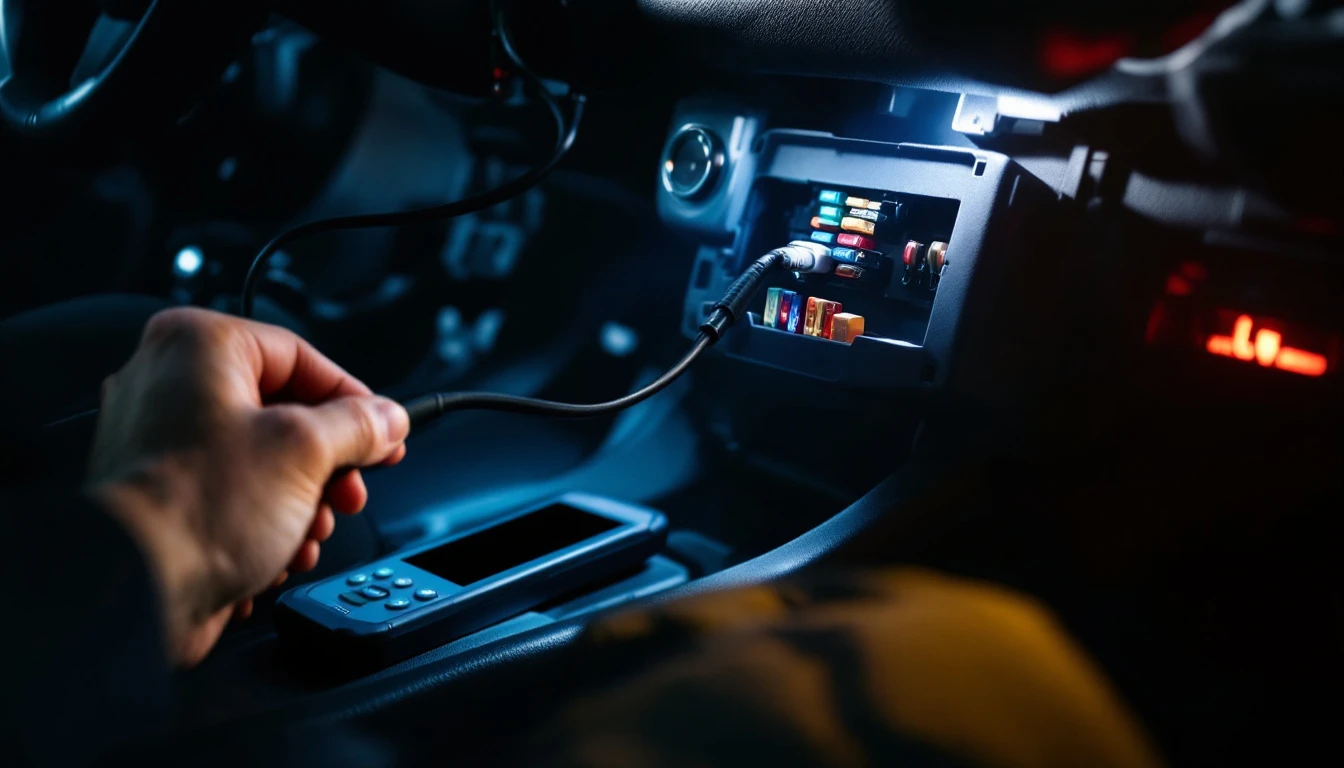
When a scan tool will not connect, the cause is usually one of six things, and as of October 2026 they are best checked in this order: no power at the diagnostic port (a blown fuse), damaged pins in the port, an aftermarket device on the network, a module holding the communication lines down, damaged network wiring, or a security gateway blocking the tool. The first three are inexpensive. When the cause turns out to be a module, programming a replacement in Fort Worth runs $150–$500 for most engine or powertrain modules and $150–$350 for a body control module.
A scanner that will not link is not a dead end. It is information. Where the communication fails, and whether the tool even powers up, narrows the fault considerably before any part is replaced.
Quick Reference: What the Scanner Does and What It Means
| What you see | Most likely cause | First check |
|---|---|---|
| Scanner does not power on at all | No battery feed or ground at the port | Fuse shared with lighter / power outlet |
| Scanner powers on, "link error" on every system | Network fault or data pins damaged | Port pins, aftermarket devices, network voltage |
| Scanner reads some modules, not others | One module offline or one network branch down | Power and ground at the silent module |
| Scanner reads everything except the engine computer | Engine computer, its relay or its fuse | ECM fuse and main relay |
| Connects with engine off, drops when cranking or running | Low voltage or electrical noise | Battery, charging system, grounds |
| Generic reader fails, factory-level tool works | Protocol or security gateway | Tool compatibility and authorization |
| Connects on other cars, never on this one | Vehicle-side fault | Everything above, in order |
| Stopped working right after an accessory install | The accessory or its wiring | Unplug the device, recheck |
How the Diagnostic Port Works
The 16-pin diagnostic connector under the dash has been standard on cars and light trucks sold in the United States since the 1996 model year. Its layout is defined by SAE standards so that any compliant tool fits any compliant vehicle.
Four of the pins matter for a no-communication fault:
- Pin 16 carries battery voltage. It powers the scan tool.
- Pins 4 and 5 are chassis ground and signal ground.
- Pins 6 and 14 carry the high-speed CAN network on most vehicles built from the 2008 model year on, when CAN became mandatory for emissions diagnostics.
- Pins 2, 7, 10 and 15 carry the older protocols used on pre-CAN vehicles and for some manufacturer-specific networks.
The scan tool is not talking to "the car." It is joining a network where a dozen or more modules — engine, transmission, body, brakes, airbags, cluster, radio — are already talking to each other. Anything that disrupts that network disrupts the scanner too. The diagnostic message format the tool uses is described in SAE's J1979 standard.
Cause 1: No Power at the Port
If the scan tool's screen stays dark when you plug it in, the port is not supplying power. A code reader with its own battery may power up but report it cannot link, for the same reason.
The battery feed to pin 16 runs through a fuse, and on a large share of vehicles that fuse is shared with the cigarette lighter or accessory power outlet. A coin dropped in the lighter socket, or a faulty phone charger, blows the fuse and takes the diagnostic port down with it. If the lighter socket is dead too, you have very likely found the problem.
Check the fuse box legend for labels such as CIG, PWR OUTLET, DLC, OBD or DIAG. Replace the fuse with one of the same rating. If it blows again immediately, something on that circuit is shorted and needs to be found before another fuse goes in.
If the fuse is good and pin 16 is still dead, the feed wire is open somewhere between the fuse box and the port. If pin 16 has power and the tool still will not light, check the grounds on pins 4 and 5.
Cause 2: Damaged Pins in the Port
The diagnostic port lives a hard life. Insurance dongles, fleet trackers, code readers and performance gauges get plugged in and yanked out for years. The female terminals inside the port spread open or push back into the connector housing, so the scan tool's pins never make contact.
Look into the port with a flashlight. Every populated cavity should hold a terminal sitting flush with its neighbors. A terminal sunk deeper than the others has been pushed back. Corrosion — green or white residue — shows up on vehicles that have had water in the footwell.
A spread or backed-out terminal can usually be re-tensioned or re-seated. It is a small repair when it is caught, and a maddening intermittent when it is not.
Cause 3: An Aftermarket Device on the Network
This is a common cause on vehicles that otherwise run fine. Anything spliced into the network or left plugged into the port can interfere with communication:
- Insurance and fleet tracking dongles
- Remote start and alarm systems
- Aftermarket radios and their interface modules
- Trailer brake controllers and lighting modules
- "Performance chips" that sit on the port
- Buy-here-pay-here starter interrupt devices
Unplug or disconnect the device and try the scan tool again. If communication returns, the device or its installation is the problem. Poorly made T-harnesses and tapped CAN wires are frequent offenders. Our guide to adding a remote start module covers how these integrate correctly.
Cause 4: A Module Holding the Network Down
The high-speed CAN network is two wires shared by every module on that bus. One module with an internal fault can hold those wires at the wrong voltage and silence all of the others, the scan tool included.
The symptoms usually go beyond the scanner: multiple warning lights, dead gauges, a no-start, or a transmission stuck in one gear. See all warning lights on and gauges dead for that presentation.
The method for finding the culprit is straightforward and takes patience:
- Measure the network at the port with the battery disconnected. Resistance across pins 6 and 14 should be close to 60 ohms on a healthy high-speed CAN bus — two 120-ohm terminating resistors in parallel. A reading near 120 ohms means one terminator or one section of the bus is missing. A reading near zero means the two wires are shorted together.
- Measure voltage with the ignition on. The two CAN lines should each sit near 2.5 volts and move in opposite directions as data flows. A line stuck at zero or at battery voltage is shorted to ground or to power.
- Unplug modules one at a time while watching the readings. When the network recovers, the last module unplugged, or the wiring to it, is the fault.
Modules exposed to water are the usual suspects: anything under a seat, in a door, behind a kick panel, or in the trunk well. After the heavy storms that roll through North Texas in spring, water intrusion is worth suspecting early.
When a module is confirmed bad, it has to be replaced and programmed to the vehicle. A used module is often an option; see the used module programming cost guide.
Cause 5: Network Wiring Damage
CAN wiring is a twisted pair that runs the length of the vehicle. It fails where harnesses flex or rub: door jambs, under seats, along the frame, near the exhaust, and anywhere a repair or accessory installation disturbed it. Rodent damage is common on vehicles that sit.
An open in one branch takes the modules on that branch offline while the rest keep talking, which is why the scan tool may read some modules and not others. A short to ground or to power takes the whole bus down.
Collision repair is another source. A harness pinched behind a replaced bumper or fender can leave a module unreachable weeks after the body work was finished. Our guide to post-collision module programming covers the related programming.
Cause 6: The Security Gateway
On many late-model vehicles the diagnostic port no longer connects straight to the network. It connects to a gateway module that decides what an outside tool may do. Stellantis vehicles — Chrysler, Dodge, Jeep, Ram — have used a secure gateway on most models since 2018, and other manufacturers have followed with their own versions.
With a gateway, a generic code reader can usually still read emissions-related codes, because that access is required. But clearing codes, running tests and programming require a tool that is registered and authenticated with the manufacturer. An unauthorized tool appears to connect and then cannot do anything useful, or reports a communication error on the functions it is locked out of.
This is not a fault. It is the vehicle working as designed. The fix is an authorized tool, not a repair. Technician access to these systems is coordinated through the National Automotive Service Task Force. Our guide to the security gateway module on Dodge, Ram and Jeep explains what the gateway does and when it has to be programmed.
Before You Blame the Car: Rule Out the Tool
A few minutes here saves hours later.
- Try the scanner on another vehicle. If it fails there too, the tool or its cable is the problem.
- Ignition fully on. Many modules do not wake with the key in accessory. On push-button vehicles, press the button without the brake until the dash is fully lit.
- Check the tool's coverage. Inexpensive readers cover generic emissions data only and cannot reach body, brake or airbag modules. "Cannot connect to ABS" from a basic reader is a limitation, not a fault.
- Check battery voltage. Below about 11.5 volts, modules drop offline and communication becomes unreliable. Charge the battery and retry.
- Bluetooth adapters have to be paired and the app set to the correct protocol. A cheap adapter is the weakest link in the chain.
What It Costs to Fix in Fort Worth
As of October 2026, the repair cost follows the cause.
- Blown fuse or re-seated port terminal: minor. Often resolved during the diagnostic visit.
- Aftermarket device removed or rewired: depends on the installation.
- Network wiring repair: quoted after diagnosis. The parts are inexpensive; the time is in locating the damage.
- Body control module programming: $150–$350.
- Engine or powertrain module programming: $150–$500, with most domestic jobs at $200–$350.
- Used module married to your VIN: $325–$1,200 depending on the module and platform.
- Two modules programmed in sequence: $425–$725.
- Gateway-related or bench-level work on locked platforms: quoted after diagnosis.
Module prices are for programming; the part is separate. For every module type side by side, see the car computer and module programming cost guide.
Why This Matters for Inspection in Tarrant County
Tarrant County is one of the Texas counties with an annual emissions test, and for 1996 and newer gasoline vehicles that test is done through the diagnostic port. If the inspection station's equipment cannot communicate with the vehicle, the test cannot be completed. A dead port is therefore not something to live with until registration is due.
After the communication fault is repaired, and especially after any module is programmed or the battery was disconnected, the emissions readiness monitors reset. They need a few days of normal mixed driving to complete before the vehicle will test as ready. The EPA's overview of vehicle emissions inspection programs explains how port-based testing works.
When to Call a Module Programming Specialist
If the cause is a fuse, a pin or an accessory, you may well fix it yourself with this guide. Call for help when:
- The fuse is good, the port has power, and nothing communicates.
- The network measurements are off and you need the offending module or wire found.
- A module has been identified as failed and needs to be replaced and programmed.
- The vehicle has a security gateway and your tool cannot get past it.
- A module was replaced and still will not talk — see new module installed, car still will not start.
We are a mobile service covering Fort Worth and Tarrant County. We carry factory-level and authorized tooling, and when a module will not communicate on the vehicle we can often read and program it directly on the bench. On Ford trucks and SUVs, for example, a failed SYNC APIM module or fuel pump driver module is a common reason a network branch goes quiet. See mobile module programming near me and our module programming service for what we cover.
Frequently Asked Questions
Why won't my scan tool connect to my car?
The most common reason is no power at the diagnostic port, usually from a blown fuse that the port shares with the cigarette lighter or accessory outlet. After that come bent or pushed-back pins in the port, an aftermarket device plugged into the port or wired into the network, a failed module holding the communication lines down, damaged network wiring, and on newer vehicles a security gateway that blocks tools that are not authorized. A scanner that is incompatible with the vehicle's protocol is also worth ruling out on another car.
Which fuse powers the OBD port?
It varies by vehicle, but the diagnostic port's battery feed on pin 16 very often shares a fuse with the cigarette lighter, the accessory power outlet or the dome and radio memory circuit. Check the fuse box legend for labels such as CIG, PWR OUTLET, DLC, OBD or DIAG. If the lighter socket is dead and the scanner will not power up, that shared fuse is the first thing to check.
Can a bad ECM stop a scan tool from connecting?
It can stop the scan tool from talking to the engine computer, and a module with an internal short can drag the whole network down so nothing responds. But when a full-system scanner cannot reach any module at all, the cause is more often port power, a ground, the network wiring or one faulty module on the bus than the engine computer specifically. Unplugging modules one at a time while watching the network is how the offender is found.
My scanner powers on but says link error. What does that mean?
It means the port has power and ground but the scanner is getting no reply on the data lines. The usual causes are a damaged or spread data pin in the port, a network fault such as a shorted or open CAN wire, a module pulling the lines down, an aftermarket alarm or tracker interfering, or an ignition that is not fully on. On some late-model vehicles a generic scanner is simply blocked by the security gateway.
Will my car fail emissions inspection if the scanner can't connect?
Yes. In Tarrant County the emissions test for 1996 and newer gasoline vehicles is performed through the diagnostic port. If the station's equipment cannot communicate with the vehicle, the test cannot be completed and the vehicle does not pass. The communication fault has to be repaired first, and after the repair the readiness monitors need time to complete.
How much does it cost to fix an OBD port that won't communicate in Fort Worth?
It depends entirely on the cause. A fuse or a pin repair is a small job. When the cause is a module, programming a replacement runs $150 to $500 for an engine or powertrain module, $150 to $350 for a body control module, and $325 to $1,200 to marry a used module to your VIN, as of October 2026. Network wiring repair is quoted after diagnosis because the time is in finding the damage.
Can you program a module if the scan tool won't connect?
Not through the port until communication is restored, because the programming session uses the same network. Once the communication fault is fixed, programming proceeds normally. If the module itself is the reason for the lost communication, it can often be read and programmed directly on the bench, outside the vehicle.
Scan tool will not connect in Fort Worth or Tarrant County? Call or text (817) 668-3801 with the year, model, what the scanner does when you plug it in, and whether the lighter socket works.