Signs of a Bad ECM: Is It the Engine Computer or Something Else?
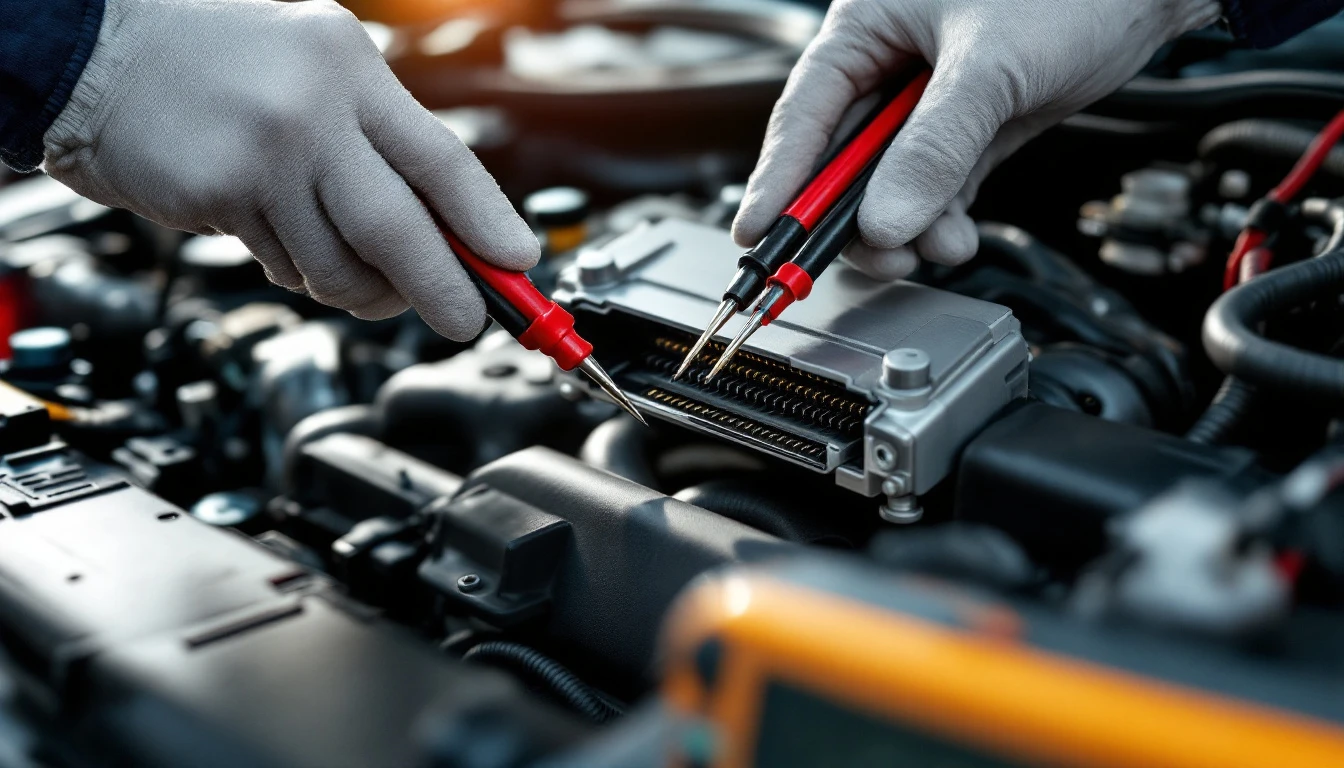
The engine computer is one of the most reliable parts on a modern vehicle and one of the most frequently misdiagnosed. As of October 2026, the symptoms that genuinely point to a bad ECM are a short list: internal control module codes (P0600–P0606), a scan tool that reaches every module except the engine computer, a single dead injector or coil driver with good wiring, a missing five-volt sensor reference, and faults that track with heat or water at the module. When the computer really is the problem, programming a replacement in Fort Worth runs $150–$500 for most jobs, plus the module.
Everything else on the usual "bad ECM symptoms" lists — rough idle, stalling, poor mileage, hard shifting, a check engine light — is caused by sensors, wiring, power supply or mechanical faults far more often than by the computer. This guide separates the two, explains how the diagnosis is actually done, and covers what it costs.
ECM, ECU and PCM are used interchangeably here. Strictly a PCM also runs the transmission; see ECU vs ECM vs PCM for the distinction.
Symptoms and What Usually Causes Them
| Symptom | Likelihood the ECM is at fault | More common causes to rule out first |
|---|---|---|
| Internal module code P0600–P0606 | High | Low system voltage, poor module ground |
| Scan tool cannot communicate with the ECM only | High | Blown ECM fuse, failed main relay, network wiring |
| One injector or coil never fires, wiring tests good | High | Open circuit in the harness, failed injector or coil |
| No five-volt reference with all sensors unplugged | High | A shorted sensor pulling the reference down |
| Fault appears only when hot, or after rain | Moderate to high | Connector corrosion, harness chafing |
| Crank, no start, security light flashing | Low | Immobilizer or key not recognized |
| Crank, no start, no codes | Low to moderate | Crank sensor, fuel pump, relay, fuse |
| Rough idle, misfire, stalling | Low | Coils, plugs, vacuum leaks, sensors |
| Harsh or erratic shifting | Low | Transmission fluid, solenoids, adaptation |
| Check engine light with ordinary sensor codes | Low | The sensor or circuit named by the code |
| Multiple unrelated warning lights at once | Low | Battery, charging system, network fault |
The pattern worth noticing: the high-likelihood rows are all about the computer's own ability to run, communicate and drive an output. The low-likelihood rows are about how the engine behaves, which is the computer reacting to information it has been given.
The Signs That Really Point to the Engine Computer
1. Internal Control Module Codes (P0600–P0606)
This family of codes is the computer reporting a problem with itself. P0601 is a memory checksum error, P0602 a programming error, P0603 and P0604 are memory faults, P0605 a read-only memory error, and P0606 a processor fault. Manufacturers add their own related codes.
These are the closest thing to a direct accusation, but even here two checks come first. Low or unstable system voltage during cranking can trip a processor code on a healthy module. And P0602 on a vehicle that recently had programming attempted usually means the programming did not complete — a software problem a reflash can fix, not a hardware failure.
2. The Scan Tool Talks to Everything Except the Engine Computer
If a scan tool can reach the transmission, body, brake and airbag modules but gets no response from the engine computer, the problem is narrowed to that module, its power and ground, or its network connection. Other modules will usually store U0100, "lost communication with ECM/PCM."
Check the fuse and the main relay that feed the computer first. A surprising number of "dead ECMs" are a five-dollar relay. If instead the scan tool cannot talk to anything, the fault is in the diagnostic connector or the network, not the engine computer — a different diagnosis covered in our guide to a scan tool that will not connect.
3. One Output Is Dead and the Wiring Is Good
Each injector, ignition coil and many solenoids are switched by a driver transistor inside the computer. Drivers fail individually, usually after the component they control shorted and drew too much current. The result is a single cylinder that never fires, with a code for that injector or coil circuit, and a new injector or coil that makes no difference.
The test is direct: with a test light or scope on the circuit, is the computer switching it or not? If the wiring from the module to the component has continuity, the component is known good, and the computer is not pulsing the circuit, the driver is gone. It is important to find and fix the shorted component first, or the replacement computer's driver will fail the same way.
4. The Five-Volt Reference Is Missing
The computer supplies a regulated five volts to its sensors. When that supply collapses, several sensors read out of range at once and the engine may not start. The usual cause is one shorted sensor or a chafed wire dragging the whole circuit down. Unplug the sensors on that circuit one at a time; if the five volts returns, you found the culprit. If every sensor is unplugged and the reference is still absent at the module with good power and ground, the regulator inside the computer has failed.
5. Heat, Vibration and Water Patterns
Electronics that work cold and fail hot, or fail over bumps, often have cracked solder joints or a failing component on the board. A fault that began after heavy rain, an engine bay pressure wash or a flooded street points at water in the module or its connector. Texas summer under-hood temperatures are hard on modules mounted on the engine or the firewall. Green or white corrosion on the connector pins is evidence; so is a water line inside the case.
6. The Check Engine Light Never Does Its Bulb Check
Turn the key on without starting. The check engine light should illuminate for a moment. If it never lights, and the bulb or cluster is fine, the computer may not be powering up at all. Combined with no communication, this is a strong sign — of the computer or its power feed.
What Imitates a Bad ECM
Most engine computers replaced in error were replaced for one of these.
A weak battery or charging fault. Low voltage makes every module misbehave. Codes set at random, communication drops, the transmission shifts oddly. If the trouble started with a dead battery or a jump start, read car acting up after a dead battery before suspecting any module.
A bad ground. The computer references every sensor reading to ground. A corroded ground strap between the engine and body shifts all of those readings and produces a scatter of unrelated codes.
Wiring damage. Harnesses chafe on brackets, rodents chew insulation, and connectors corrode. An intermittent open in a sensor wire looks exactly like an intermittent computer.
The immobilizer. A crank-no-start with a flashing security light is the anti-theft system refusing the key, not a failed computer. The engine computer is doing what it was told. See car starts then immediately dies and immobilizer programming when all keys are lost.
A failed sensor. A crank position sensor that quits when hot stalls the engine with no warning and often no code. That is a sensor, tested as a sensor.
Another module. A fuel pump driver module, a body control module or a failed network gateway can each stop an engine or light the dash. On Ford trucks the fuel pump driver module is a classic example of a no-start blamed on the PCM. When several systems fail together, see all warning lights on and gauges dead.
Corrupted or outdated software. A computer with good hardware and bad software behaves badly. Manufacturers publish calibration updates for specific drivability complaints, and an interrupted programming session can leave a module half-written. Both are fixed with a reflash at $175–$325, not a new part.
How a Proper Diagnosis Is Done
A defensible ECM diagnosis proves the computer's inputs and supplies are good before judging its outputs. In order:
- Battery and charging. Resting voltage, cranking voltage, and charging voltage. Nothing else is meaningful until these pass.
- Full-vehicle scan. Every module, not just the engine. Which modules respond, which do not, and what each has stored tells you whether the problem is one module or the network.
- Power and ground at the module connector, under load. A wire can show twelve volts with a meter and still be unable to carry current. Loading the circuit with a test lamp finds the corroded feed a meter misses.
- Five-volt reference and sensor grounds.
- Network integrity. Resistance and voltage on the communication lines.
- The specific output in question. Is the computer commanding the injector, coil, relay or solenoid that is not working?
- Visual inspection of the module and connector for water, corrosion, heat damage or a burned smell.
- Software status. Is the calibration current, and does the module accept programming?
Only when steps one through five pass and step six fails is the computer condemned. Replacing a module without this sequence is how owners end up paying for a computer and still having the original problem. The vehicle communication standards behind this testing are published by SAE International, and the diagnostic system itself exists because of federal emissions requirements.
Repair, Replace, or Reprogram: What Each Costs
As of October 2026, typical mobile prices in Fort Worth by outcome:
- Software corrupted or outdated — reflash the existing computer: $175–$325.
- General ECM or PCM programming — standard setup or reprogram: $150–$500.
- New replacement module (domestic) — program a blank module to VIN, options and immobilizer: $275–$475 plus the module.
- Used module married to your VIN (domestic / Asian) — rewrite donor VIN and security data: $325–$500.
- Used module married to your VIN (European) — bench-level memory work: $500–$1,200.
- Immobilizer lockout after the swap — clear the lockout and resynchronize: $175–$325.
- Engine and body module paired together — two-module sequence: $425–$725.
A few points on choosing between them.
Cloning preserves your keys. If the original computer's memory can still be read, its data — VIN, immobilizer values, learned adaptations — can be copied into a matching replacement. The car then accepts the replacement as the original and no security relearn is needed. Our guide to module cloning versus programming explains when cloning is possible.
Used modules are platform-dependent. A used computer is a sound way to save money on many domestic and Asian vehicles and impractical on some newer and European ones. Part number and hardware version must match exactly. See used ECM and PCM programming to VIN.
The part is separate from the programming. Our prices above are for the programming. The module cost is on top, and it varies enormously by vehicle. For how the two add up, see how much ECM replacement costs and the full ECU programming cost guide.
Fix the cause first. If a shorted coil killed a driver, a new computer installed onto the same shorted coil will fail on the first start. If water got in, find where.
Is It Safe to Keep Driving?
It depends on what is failing. A computer with an intermittent internal fault can shut the engine off without warning, and losing power steering and brake assist at speed is a real hazard. A stall at a light on Camp Bowie is an inconvenience; a stall merging onto I-35W is not. If the engine has cut out while driving even once and the cause is unknown, treat it as unsafe until diagnosed.
Check for open recalls as well. Manufacturers do recall engine computers and their software, and a recall repair is free at the dealer. You can search your VIN at NHTSA's recall lookup.
When to Call a Programming Specialist
Call a mechanic or a diagnostic shop when the question is still "what is wrong." Call a programming specialist when the diagnosis points at the computer and the question becomes "how do we replace or reprogram it without a tow."
That is the work we do. We are a mobile service across Fort Worth and Tarrant County, we program new and used engine computers at the vehicle, and we coordinate with the shop that did the diagnosis. Most on-vehicle sessions take thirty minutes to two hours; see how long ECU and module programming takes. If you are not sure who handles this kind of work locally, who reprograms an ECM near me answers that directly.
Helpful to have ready: the VIN, the codes that are stored, what has already been replaced, and the part number from the label on the computer. See ECU programming in Fort Worth or our ECU programming service for coverage.
Frequently Asked Questions
What are the signs of a bad ECM?
The signs that genuinely point to the engine computer are internal control module codes in the P0600 to P0606 range, a scan tool that can talk to every module except the engine computer, one injector or coil driver that is dead while its wiring tests good, a missing five-volt sensor reference with the sensors unplugged, and faults that come and go with heat or follow water intrusion at the module. Rough running, stalling and a check engine light alone are not enough, because wiring and sensors cause those far more often.
Can a bad ECM cause a car not to start?
Yes. A failed engine computer can leave the car cranking with no spark or no injector pulse, or not cranking at all on vehicles where the computer controls the starter relay. But a no-start is caused far more often by a weak battery, a blown fuse or relay, a failed crank sensor, a fuel delivery problem or an immobilizer that does not recognize the key. Those have to be ruled out before the computer is condemned.
How do I test whether my ECM is bad?
A proper test checks the things the computer needs before judging the computer. That means battery voltage, every power and ground at the module connector under load, the five-volt reference, and network communication. Then the suspect output is tested directly, for example by checking whether the computer is commanding an injector that is not firing. Only when power, ground, wiring and inputs are all proven good and the output is still missing is the module itself the fault.
How much does it cost to fix a bad ECM in Fort Worth?
As of October 2026, ECM and PCM programming from a mobile specialist in Fort Worth runs $150 to $500 for most jobs. A software reflash is $175 to $325, setting up a new domestic module is $275 to $475 plus the part, and marrying a used module to your VIN is $325 to $500 on supported domestic and Asian platforms or $500 to $1,200 on European bench-level work. The module itself is a separate part cost.
Can I just swap in a used ECM from a junkyard?
Not on most vehicles built since the late 1990s. A used engine computer carries the donor car's VIN and immobilizer data, so it usually will not start your engine until it is programmed to your vehicle. The part number and hardware version also have to match. On supported platforms a used module married to your VIN is a legitimate way to save money; on some newer and European platforms it is difficult or not possible.
Will a bad ECM always turn on the check engine light?
No. A computer with a failing processor or memory often sets an internal fault code, but a computer that has lost power, ground or its ability to communicate may set nothing at all, because it is not running well enough to report. A check engine light that does not illuminate briefly when you first turn the key on is itself a clue worth mentioning.
Can an ECM be repaired instead of replaced?
Sometimes. Corrupted software can often be restored with a reflash, and that is the least expensive outcome. Physical damage such as a burned driver circuit, corrosion from water or cracked solder joints is board-level electronics repair, which is practical on some modules and not on others. When the original cannot be saved, cloning its data into a replacement keeps your keys and immobilizer working without a full security relearn.
Diagnosis pointing at the engine computer in Fort Worth or Tarrant County? Call or text (817) 668-3801 with the VIN, the stored codes and the part number on the module, and we will tell you which route — reflash, clone, used or new — makes sense for your vehicle.