Engine Swap Computer Programming Cost in Fort Worth (2026)
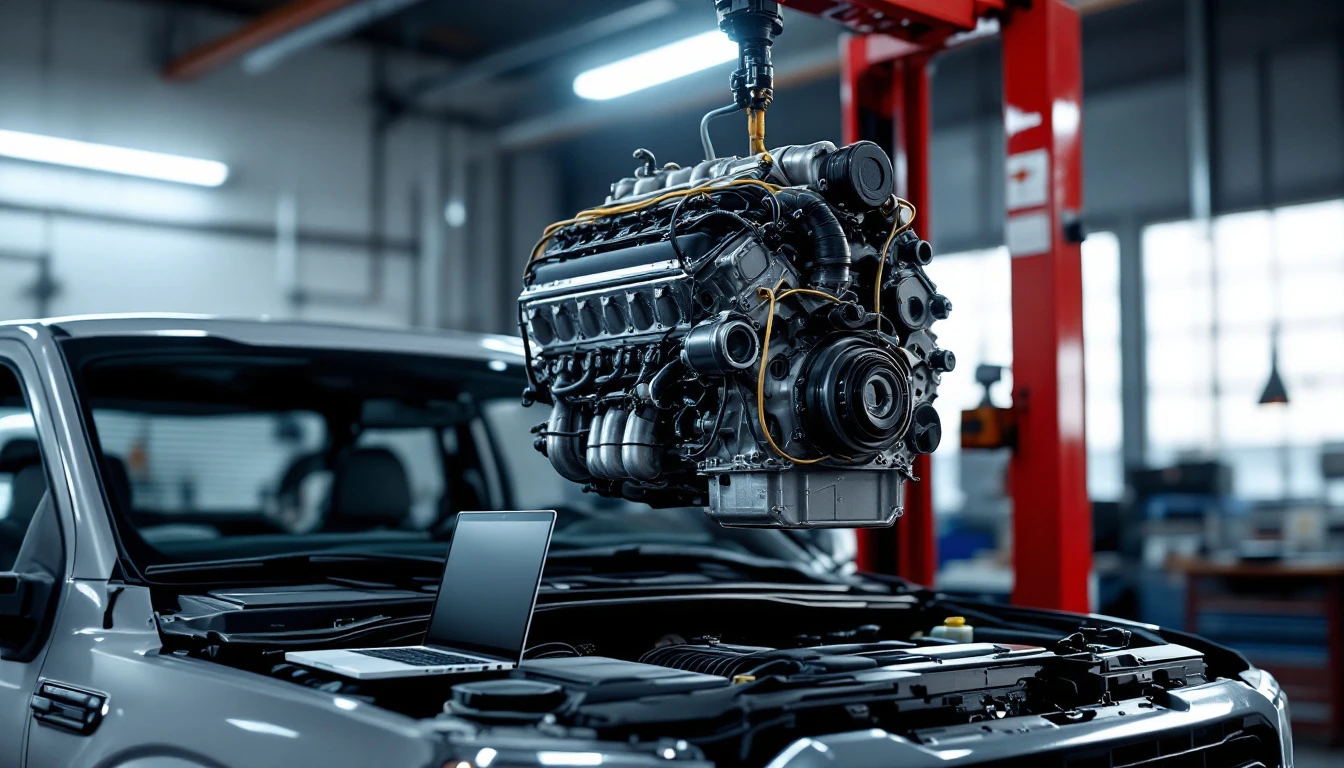
As of October 2026, computer programming after an engine swap in Fort Worth costs $150–$500 for most jobs from a mobile specialist. A like-for-like replacement engine that keeps its original computer usually needs only relearn procedures ($150–$500) or a calibration reflash ($175–$325). When the donor engine's computer goes in with it, marrying that used PCM to your VIN runs $325–$500 on supported domestic and Asian platforms and $500–$1,200 on European bench-level work.
The price depends less on the engine than on one decision made before the engine goes in: which computer will run it. This guide prices each swap scenario, explains what the computer actually needs in each one, and shows how to avoid paying for programming a swap never required.
A note on terms: ECM, ECU and PCM all refer to the engine computer. Strictly, a PCM controls the engine and transmission in one module. We use PCM here because most swap questions involve trucks and cars built that way. Our guide to ECU vs ECM vs PCM covers the difference.
Engine Swap Programming Cost by Scenario
| Swap scenario | What the computer needs | Typical mobile price |
|---|---|---|
| Same-variant replacement engine, original PCM kept | Relearns only (crank variation, idle, throttle) | $150–$500 |
| Same engine family, calibration update required | Reflash of the existing PCM | $175–$325 |
| Original PCM kept, security lockout after the swap | Immobilizer lockout clearance | $175–$325 |
| Donor PCM installed with the engine (domestic / Asian) | Used PCM married to your VIN and keys | $325–$500 |
| Donor PCM installed with the engine (European) | Bench-level memory work on the donor module | $500–$1,200 |
| New blank PCM purchased for the swap (domestic) | New module setup: VIN, options, immobilizer | $275–$475 plus the module |
| PCM and body module must be paired in sequence | Two-module programming sequence | $425–$725 |
| Transmission adaptation after the swap | Adaptation reset and relearn | $150–$500 |
| Different transmission control module | Standalone TCM setup | Quote required after diagnosis |
| Cross-generation or cross-platform swap | Custom integration; varies by combination | Quote required after diagnosis |
These are the same bands used across our module work. For every module type priced side by side, see the car computer and module programming cost guide; for the engine computer on its own, see ECU programming cost by job type.
Scenario 1: Same Engine, Original Computer Kept ($150–$500, Sometimes Nothing)
This is the most common swap in Tarrant County: a worn or damaged engine replaced with a used, remanufactured or crate engine of the same variant, with the factory wiring harness and the original PCM left in place.
The original PCM already knows your VIN, your keys and your options. It does not need to be "programmed to the new engine," and anyone quoting a full programming job here is quoting work that is not required. What the computer does commonly need:
- Crankshaft position variation relearn. Many GM engines store a learned map of the reluctor wheel. After an engine change the stored map no longer matches, and the PCM sets a code and disables misfire detection until the relearn is run with a scan tool.
- Idle and throttle relearn. An electronic throttle body that was cleaned, swapped or simply disconnected for the job may idle high, hunt, or stall until it relearns its closed position. See our throttle body relearn guide.
- Fuel trim and adaptation reset. The PCM spent years compensating for the old engine's wear. Clearing those learned values lets it adapt to the replacement instead of fighting it.
- A check for calibration updates. If the manufacturer has published a newer calibration for your VIN, a reflash at $175–$325 is cheap insurance while the tool is connected.
Many shops perform these relearns themselves as part of the installation. Where a shop does not have the tooling, the relearn-only visit falls in the same range as our other calibrations and relearns.
Scenario 2: Donor Engine Arrives With Its Own Computer ($325–$1,200)
Salvage yards often sell an engine as a "complete dropout": engine, harness and PCM pulled together from the donor vehicle. Installers like this because everything plugs in. The problem shows up at the first turn of the key.
That donor PCM is married to a different vehicle. It carries the donor VIN, and on most vehicles built since the late 1990s it shares a security value with the donor's body module, instrument cluster or immobilizer unit. Your car's other modules do not recognize it, so the engine cranks and will not start, or starts and stalls within seconds. A security light flashing during cranking is the usual sign.
The fix is the same job as any used engine computer: the donor PCM is rewritten with your VIN and synchronized to your immobilizer and keys.
- Domestic and Asian platforms that support it: $325–$500. Much of the GM, Ford, Stellantis, Toyota, Honda, Nissan and Hyundai/Kia range can be handled through the diagnostic port or with straightforward bench work.
- European platforms: $500–$1,200. BMW, Mercedes-Benz, Audi and Volkswagen engine computers store security data that typically has to be read and rewritten directly from the module's memory. Part numbers and hardware versions must match.
Whether a specific module can be reused at all is platform-dependent. Some late-model computers are locked to their original VIN after first programming. That is why we ask for both part numbers and both VINs first. Our used ECM and PCM programming to VIN guide and the broader used module programming cost guide go deeper on which modules transfer and which do not.
The cheaper alternative in many cases: if the donor engine is the same variant as yours, leave the donor PCM on the shelf and keep your original. You are then back in Scenario 1.
Scenario 3: A New Computer Bought for the Swap ($275–$475 Plus the Module)
Sometimes the original PCM failed along with the engine, for example after an overheat that cooked an injector driver, or a hydrolock that followed flood damage. A new blank module arrives with no VIN, no calibration and no key data. Setting it up means loading the correct calibration for your VIN, writing the VIN and options, and pairing the immobilizer so your existing keys start the car.
On domestic vehicles that setup runs $275–$475 plus the cost of the module. When the body control module must be programmed in the same session so the two share a fresh security value, the two-module sequence runs $425–$725. For how the part cost and the labor add up on a failed engine computer, see how much ECM replacement costs.
Scenario 4: A Different Year or Variant of the Same Engine Family
This is where owners get surprised. A 5.3-liter from a truck five years newer, or the "same" four-cylinder from a different model, can bolt in and still disagree with your original computer in ways that matter:
- Crank and cam reluctor patterns changed mid-generation on several engine families. A mismatch means no sync and no start, regardless of programming.
- Cylinder deactivation, variable valve timing and direct injection may be present on one engine and absent on the other. The original PCM has no outputs or strategy for hardware it was never built to control.
- Throttle and pedal electronics differ between years, and the connectors do not always tell you.
- Emissions hardware such as oxygen sensor count and evaporative system design is tied to the calibration.
The usual resolution is one of two paths. Either the engine is converted mechanically to match the original computer (swapping reluctors, sensors and intake components from the old engine), or the donor PCM and harness sections are used and the donor PCM is married to the car as in Scenario 2. Which is cheaper depends on the pair of engines, and it is worth settling before the engine is installed, while swapping a reluctor wheel is still a ten-minute job.
Truly cross-platform swaps — a different engine family, a different manufacturer, or a late-model drivetrain into an older vehicle — are custom integration work. The modules involved may include the PCM, TCM, body module, cluster and, on newer vehicles, a security gateway. Those jobs are quoted after diagnosis because no two are alike, and some combinations are not practical to make work through factory-style programming at all. We will say so plainly rather than take a deposit and find out later.
The Immobilizer: Why Swapped Engines Crank and Do Not Start
The immobilizer is the single largest source of programming bills after an engine swap, so it is worth understanding in one paragraph.
Your key carries a transponder or a proximity signal. A module in the car — the body control module, a dedicated immobilizer unit, or the cluster, depending on the make — verifies the key and then sends an authorization to the engine computer. The engine computer checks that authorization against a stored value. If the two do not match, it disables fuel, spark or the starter.
When an engine swap leaves all of the original modules in place, that chain is untouched. When the swap introduces a different PCM, the chain is broken at the last link. Fixing it means either teaching the new PCM your car's value or, on platforms that work the other way, relearning the security link across the modules. On older GM vehicles this is the familiar VATS, PassLock and Passkey family; our GM VATS and PassLock guide explains how those behave. On most other makes the procedure is described in our immobilizer and anti-theft programming cost guide.
If the security link was disturbed and the system has locked itself out after repeated start attempts, clearing that lockout runs $175–$325. Bring every key you own to the appointment. On some platforms keys that are not present during the relearn stop working.
Does the Transmission Computer Need Programming Too?
If the transmission stays in the vehicle, usually not. The transmission control module, whether it is a separate box or part of the PCM, has learned shift pressures matched to the old engine's output. After the swap it benefits from an adaptation reset and relearn at $150–$500, especially if shifts feel harsh or flare.
If the swap includes a different transmission, the picture changes. A replacement TCM has to be configured for your VIN and, on many platforms, share a security value with the engine computer before it will communicate. Because so many vehicles integrate transmission control into the PCM or the valve body, a standalone TCM job is quoted after diagnosis. Our guide to programming a used TCM to your VIN covers the common cases, and if the vehicle is stuck in one gear after the swap, start with transmission limp mode diagnosis.
What Changes the Price
Which computer runs the engine. Original PCM kept is the low end. Donor PCM installed is the middle. Cross-platform integration is the open-ended case.
The make. Domestic and most Asian platforms are generally permissive. European engine computers push a used-module job to $500–$1,200 because the work moves from the diagnostic port to the bench.
The model year. Newer vehicles add online authorization, security gateways and modules that lock to a VIN after first use. A 2008 truck and a 2022 truck with the same displacement are very different programming jobs.
How many modules changed. An engine alone is one conversation. On Ford trucks, for example, a donor harness can bring a different fuel pump driver module into the picture. An engine, transmission and harness from a donor can mean PCM, TCM and sometimes the body module, programmed in a required order at $425–$725 for a two-module sequence.
Whether the engine currently runs. A vehicle that starts and drives to an appointment is a programming job. A vehicle that will not start is a diagnostic job first, because wiring, grounds, sensors and fuel delivery all produce the same crank-no-start as an immobilizer mismatch. See new module installed, car still will not start for the order we check things in.
Battery voltage and access. Programming requires stable voltage. A weak battery in a vehicle that has sat during a long engine job is a common reason sessions fail, so we connect a battery support unit before writing anything.
Emissions and What Programming Cannot Fix
Tarrant County is one of the Texas counties that requires annual emissions testing for most gasoline vehicles. A swapped vehicle is tested against the standards for the vehicle, and the engine combination has to make sense.
The EPA's engine switching guidance sets out the principle: after an engine change, the vehicle should be identical to a configuration the manufacturer certified, of the same or a newer model year than the chassis, with every emissions component for that engine installed and working. Putting an older engine in a newer vehicle, or deleting catalytic converters, oxygen sensors or evaporative controls, is treated as tampering.
Programming is not a way around that. We do not disable emissions monitors, turn off catalyst or oxygen sensor diagnostics, or write calibrations intended to defeat emissions controls. What programming legitimately does is make a compliant engine and computer combination work correctly in your vehicle.
One practical point: after any PCM programming or battery disconnect, the on-board readiness monitors reset to "not ready." The vehicle needs to complete its drive cycle — typically a few days of mixed driving — before an emissions test will accept it. Plan the swap so the test is not due the day after.
How to Keep the Programming Bill Small
- Decide the computer question before installation. Tell the installer and the programmer which PCM will run the engine while the old engine is still in the bay.
- Send both VINs and both part numbers. The chassis VIN, the donor VIN if known, and the hardware numbers on both computers let us confirm compatibility before anyone buys anything.
- Keep the original computer if the engines match. It is the cheapest correct answer and it preserves your keys.
- Do not let anyone crank a no-start for ten minutes. Repeated failed starts can trigger a security lockout and add $175–$325 to the job.
- Keep every key with the vehicle. Security relearns can drop keys that are not present.
- Ask the installer what relearns they performed. A crank relearn already done is one you do not pay for twice.
- Do not buy a "pre-programmed" computer online without checking. A module flashed to a VIN by mail still has to be married to your immobilizer at the car on most platforms.
Dealer, Engine Shop, or Mobile Programming Specialist
The engine installer is the right place for mechanical relearns if they have the scan tool for it. Many do.
The dealership can program new modules for vehicles it sells, at bay labor rates and after a tow if the vehicle does not run. Dealers generally will not program used modules, and many will not touch a swap that departs from factory configuration.
A mobile programming specialist comes to the shop or driveway where the vehicle already sits, which matters when it will not start. Used-module work, immobilizer synchronization and multi-module sequences are routine. Our comparison of dealer versus locksmith module programming covers the trade-offs, and how long ECU and module programming takes gives realistic timelines: thirty minutes to two hours for most on-vehicle work, longer when a module has to be opened on the bench.
We are a mobile service covering Fort Worth and Tarrant County, and we work alongside engine installers regularly. See ECU programming in Fort Worth and our module programming service for what we cover.
Frequently Asked Questions
How much does computer programming cost after an engine swap in Fort Worth?
As of October 2026, most engine swap programming from a mobile specialist in Fort Worth runs $150 to $500. A like-for-like replacement engine that keeps the original computer often needs only relearn procedures at $150 to $500 or a calibration reflash at $175 to $325. If the donor engine's computer is installed too, marrying that used PCM to your VIN runs $325 to $500 on supported domestic and Asian platforms and $500 to $1,200 on European bench-level jobs.
Do I need to reprogram the computer if I replace my engine with the same engine?
Usually not. If the replacement is the same engine family and you keep your original PCM, the computer already holds your VIN, your calibration and your immobilizer data. What it typically needs is a set of relearns, such as the crankshaft position variation relearn on many GM engines and an idle or throttle relearn, plus a check for any open calibration updates. Programming becomes necessary when the engine is a different year, a different variant, or arrives with its own computer.
Why will my car crank but not start after an engine swap?
If the installer also swapped in the donor vehicle's computer, the immobilizer is the most common cause. The donor PCM is still married to the donor car's keys and body module, so your car authorizes nothing and cuts fuel or spark. A security light that flashes or stays on while cranking points this way. Other common causes are unplugged or mismatched sensor connectors, a crank sensor reluctor that differs between years, and a missing ground strap.
Can you program the used computer that came with my junkyard engine?
On many domestic and Asian platforms, yes. The donor PCM is rewritten with your VIN and synchronized to your immobilizer and keys. On some newer and most European platforms the module is locked to its original vehicle and needs bench-level memory work, or cannot be reused at all. Send the part numbers from both computers and both VINs before the engine goes in and we can tell you which case you are in.
Is it cheaper to keep my original computer or use the donor one?
Keeping your original computer is almost always cheaper when the engines are the same variant, because nothing has to be married to the car. Using the donor computer makes sense when the replacement engine is a different year or calibration that your original PCM cannot run correctly. In that case the used-module programming charge is the price of making a different engine behave properly.
Does the transmission computer need programming after an engine swap?
Only in certain cases. If the transmission and its control module stay in the car, the TCM usually needs an adaptation reset and relearn rather than programming. If the swap brings a different transmission or a different TCM, that module has to be set up for your VIN and, on many platforms, share a security value with the engine computer. Standalone TCM programming is quoted after diagnosis because many vehicles build the transmission control into the PCM.
Will a swapped engine pass emissions testing in Tarrant County?
It can, if the result matches a configuration the manufacturer certified. The EPA's engine switching guidance says the swapped vehicle should be identical to a certified configuration of the same or a newer model year, with all the emissions equipment for that engine present and working. Programming cannot make a non-compliant combination legal, and we do not disable emissions monitors. The readiness monitors also have to complete after any programming before the test will pass.
Planning an engine swap in Fort Worth or Tarrant County, or sitting on one that cranks and will not start? Call or text (817) 668-3801 with both VINs and the part numbers on both computers, and we will tell you what the programming involves before the engine goes in.